If you learned to program before ChatGPT became popular, you probably know this situation.
You're building an application, an error you don't understand shows up, and you paste the full message into Google.
Among the first results is a Stack Overflow post.
You click through, find a question from someone who had exactly the same problem and, with a bit of luck, an answer with hundreds of upvotes.
You copy part of the code, check that it works and keep going.
For years, that was one of the most common routines among developers.
But something changed.
Today you can paste that same error into ChatGPT, Claude or a coding assistant and ask it to explain the error, analyze your code and propose a fix.
You don't even need to leave your editor.
And that convenience is transforming one of the most important technical communities on the Internet.
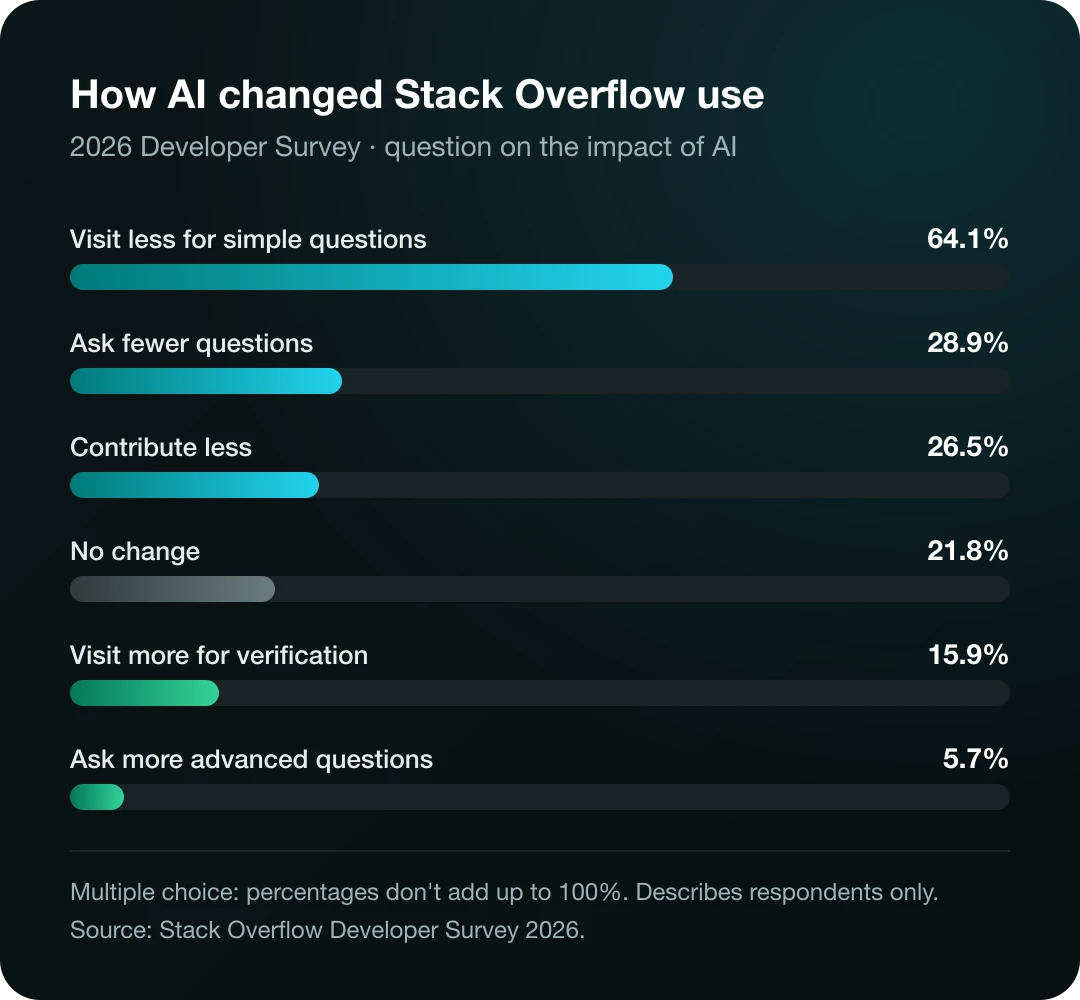
According to the 2026 Stack Overflow developer survey, 64.1% of those who answered the question about AI's impact say they now visit the platform less for simple questions.
In addition, almost 29% say they ask fewer questions.
Are we witnessing the end of Stack Overflow?
Not exactly. But its role in software development is changing profoundly.
What is Stack Overflow and why was it so important for programmers?
Stack Overflow is a programming question-and-answer platform founded in 2008 by Jeff Atwood and Joel Spolsky.

It works on a simple idea: one person posts a technical problem and other members of the community can answer it.
Answers can receive votes, comments and corrections. In addition, the person who asked can accept an answer as the solution.
This made it possible to build a huge public library of technical knowledge.
For example, someone could look up how to fix a JavaScript error, configure a database or understand how a particular Python function behaves.
And the most interesting part was that many of the answers came from people who had faced similar problems in real projects.
Stack Overflow also helped popularize a way of learning based on sharing concrete problems and reproducible solutions.
There was no need to write a full tutorial.
It was enough to ask a good question, include the necessary context and explain what had been tried.
Over time, millions of posts became reference resources for professionals and beginners alike.
But that model depended on something essential: developers continuing to visit the platform, ask questions and take the time to answer.
The arrival of AI assistants began to change that behavior.
The drop in questions on Stack Overflow is real
To understand the scale of the change, we can look at the historical question records.
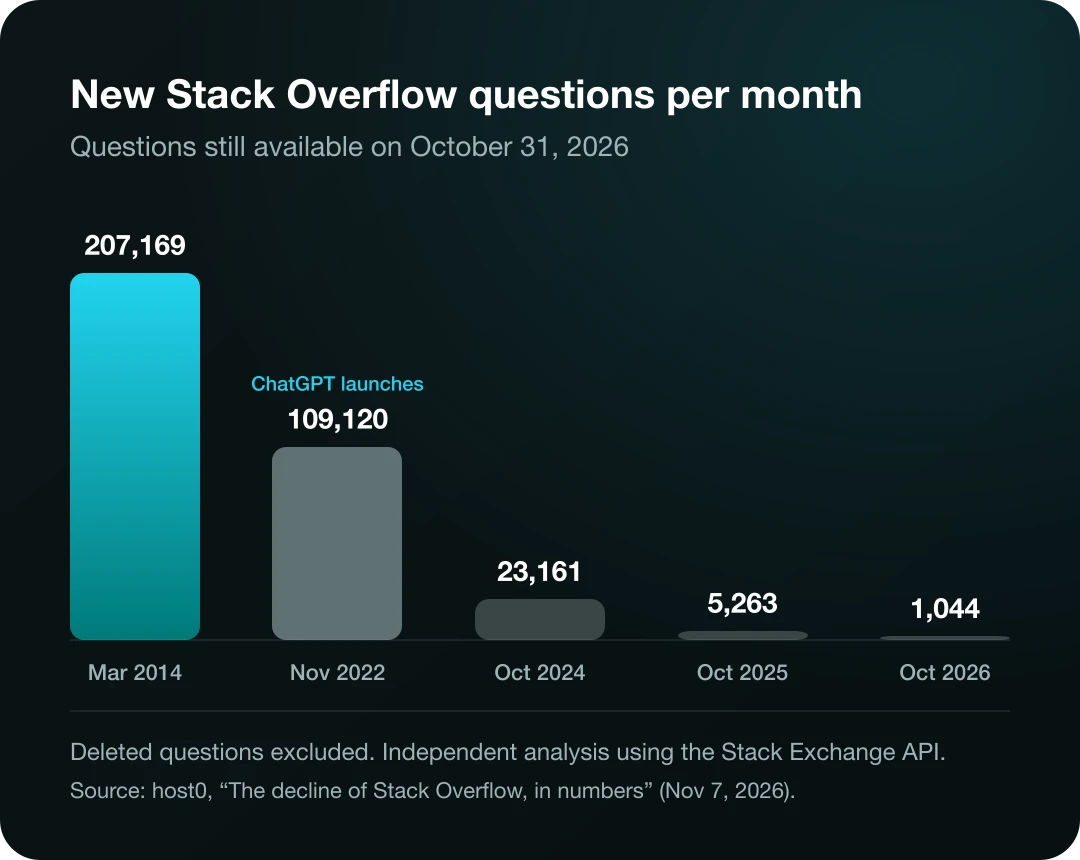
An independent analysis published on November 7, 2026, built on the public Stack Exchange API, identified approximately 207,000 questions for March 2014, one of the busiest months in the site's history.
In November 2022, the month ChatGPT appeared, the figure was around 109,000 questions.
And in October 2026, the same analysis recorded just over 1,000 questions.
The difference is enormous.
Between November 2022 and October 2026, the monthly volume observed in that series fell by approximately 99%.
However, these data need context.
The analysis counts the questions that were still available when the API was queried, on October 31, 2026. Deleted questions may no longer appear, so the historical figures do not necessarily represent the exact number originally posted.
We should also remember that Stack Overflow had already started losing activity before ChatGPT arrived.
That is why it is not correct to claim that the entire decline is explained solely by artificial intelligence.
Other factors, such as changes in moderation, the evolution of educational resources, the rise of alternative communities and the way developers search for information, may also play a role.
Even so, the size of the decline is hard to ignore.
Source of the historical analysis: Stack Overflow Decline — analysis based on the Stack Exchange API.
What changed when ChatGPT appeared?
Until late 2022, solving a technical problem online usually meant searching for information across different pages.
A developer might check the official documentation, review several answers and combine code snippets until finding a solution.
AI assistants brought another option.
Now you can describe the problem in natural language and get an answer tailored to your situation.
For example, before you might search for:
"JavaScript undefined is not a function".
And then go through multiple results to understand the error.
Today you can explain:
"I'm building an application in JavaScript. This function throws an error when the user doesn't have an active session. Explain why it happens and how to fix it without changing the behavior for other users".
The AI can analyze the description and propose a solution in context.
If you provide the relevant code, it can even point to specific lines.
This removes some of the work of navigating between multiple posts.
But there is an important difference.
Getting a personalized answer does not mean getting a correct answer.
AI can invent functions, rely on outdated documentation or suggest solutions that introduce new problems.
And this is where the story gets more interesting.
Developers are using Stack Overflow less for simple questions
The official 2026 developer survey offers a direct perspective on this change.
When Stack Overflow asked how artificial intelligence had changed the way people use the platform, it got the following results:
| Change in behavior | Percentage |
|---|---|
| Visit less for simple questions | 64.1% |
| Ask fewer questions | 28.9% |
| Contribute less to the community | 26.5% |
| No change in my behavior | 21.8% |
| Visit more to verify answers | 15.9% |
| Ask more advanced questions | 5.7% |
Participants could select several options, so the percentages do not add up to 100%.
In addition, these are answers self-reported by participants, not usage measurements. The survey is voluntary, so it describes its participants and not necessarily all developers worldwide; its published methodology explains how the responses were processed.
The takeaway is fairly clear.
A large share of respondents are using AI to solve problems that previously might have taken them straight to Stack Overflow.
But there is also a group that now uses the platform to check information.
That suggests an interesting shift: Stack Overflow may go from being the first place we look for answers to becoming one of the places where we verify what AI tells us.
You can review the rest of the participation results in the community section of the survey.
Source: Stack Overflow Developer Survey 2026 — Impact of AI on community usage.
The paradox: developers use AI, but don't always trust it
Here is one of the most interesting findings of the entire research.
Although AI assistants have become deeply embedded in programming work, their answers still raise distrust.
Stack Overflow's 2025 survey revealed that 46% of participants distrusted the accuracy of AI tools, while approximately 33% trusted them.
In addition, 66% cited as one of their main frustrations getting solutions that look correct but contain errors.
In 2026, adoption advanced even further.
According to the new survey, 69.3% of participants in the relevant question use AI tools to generate code in areas they know, while 63.8% use them to debug or refactor.
At the same time, 48% of respondents to the trust question said they trust AI output when they can easily verify it.
It's a combination worth paying attention to.
Developers use AI because it can speed up tasks.
But many still consider it necessary to review what it produces.
And that makes sense.
When an assistant proposes code, it can explain how it supposedly works in a convincing way.
However, a convincing explanation is no substitute for a test.
Sources: Stack Overflow Developer Survey 2025 and Developer Survey 2026 — AI.
Why are ChatGPT, Claude and GitHub Copilot changing programming?
The evolution of AI tools has not been limited to answering questions.
Today's coding assistants can integrate into development environments and work on a project's files.

For example, GitHub Copilot can help complete code and analyze tasks within supported programming workflows.
Claude Code and Codex offer capabilities to work on repositories, identify needed changes and carry out development tasks, depending on the tools and permissions available.
This reduces the need to manually copy every error into a website.
Imagine you're working on an application with twenty related files.
An assistant connected to the project can look at different files to understand how its components communicate.
That can be more practical than posting an isolated question, because the context of the error may be spread across several parts of the code.
But it also introduces risks.
If the assistant misreads the architecture, it may modify files it shouldn't.
If it relies on incorrect information, it may introduce vulnerabilities or bugs that are hard to detect.
That's why code reviews, automated tests and version control remain important.
AI can speed up implementation.
It does not remove the responsibility of checking that the software works.
Is AI using the knowledge Stack Overflow built?
This is another interesting part of the debate.
Stack Overflow's public answers contain years of knowledge, examples and technical solutions.
That kind of information has been valuable both for developers and for companies building artificial intelligence tools.
In May 2024, Stack Overflow announced a partnership with OpenAI related to access to technical knowledge through its OverflowAPI platform.
The stated goal was to help improve AI-assisted development experiences and the attribution of the knowledge used.
This relationship raises an important question:
What happens when artificial intelligence uses information created by human communities, but users stop visiting and contributing to those communities?
If fewer and fewer people post new questions and answers, the renewal of that knowledge may be affected.
This does not mean AI models depend exclusively on Stack Overflow.
There are also repositories, official documentation, technical publications and many other sources.
But the sustainability of knowledge communities remains relevant.
An AI tool can summarize a solution someone posted.
However, that knowledge originally had to be researched, documented and shared.
Source: Stack Overflow and OpenAI announce partnership in 2024.
Is Stack Overflow disappearing?
It depends on what we mean by disappearing.
Stack Overflow has not shut down: the site is still up and running and its content remains available.
If we're talking about new public questions, activity has dropped very significantly.
If we're talking about usefulness, there is still an enormous amount of historical information that can help solve problems.
And if we're talking about the company, Stack Overflow has also developed products aimed at managing technical knowledge within organizations.
For example, Stack Overflow for Teams lets work groups centralize questions, answers and documentation.
In these environments, a company may need a source of knowledge reviewed and maintained by its own professionals.
Artificial intelligence can help query that information.
But that does not automatically make the human process of verifying and updating it unnecessary.
In fact, according to the 2026 survey, when developers need work-related answers, 71.9% turn to teammates and 62.7% consult code repositories or their comments.
Internal documents and knowledge bases are also important, used by approximately 60% of participants in that question.
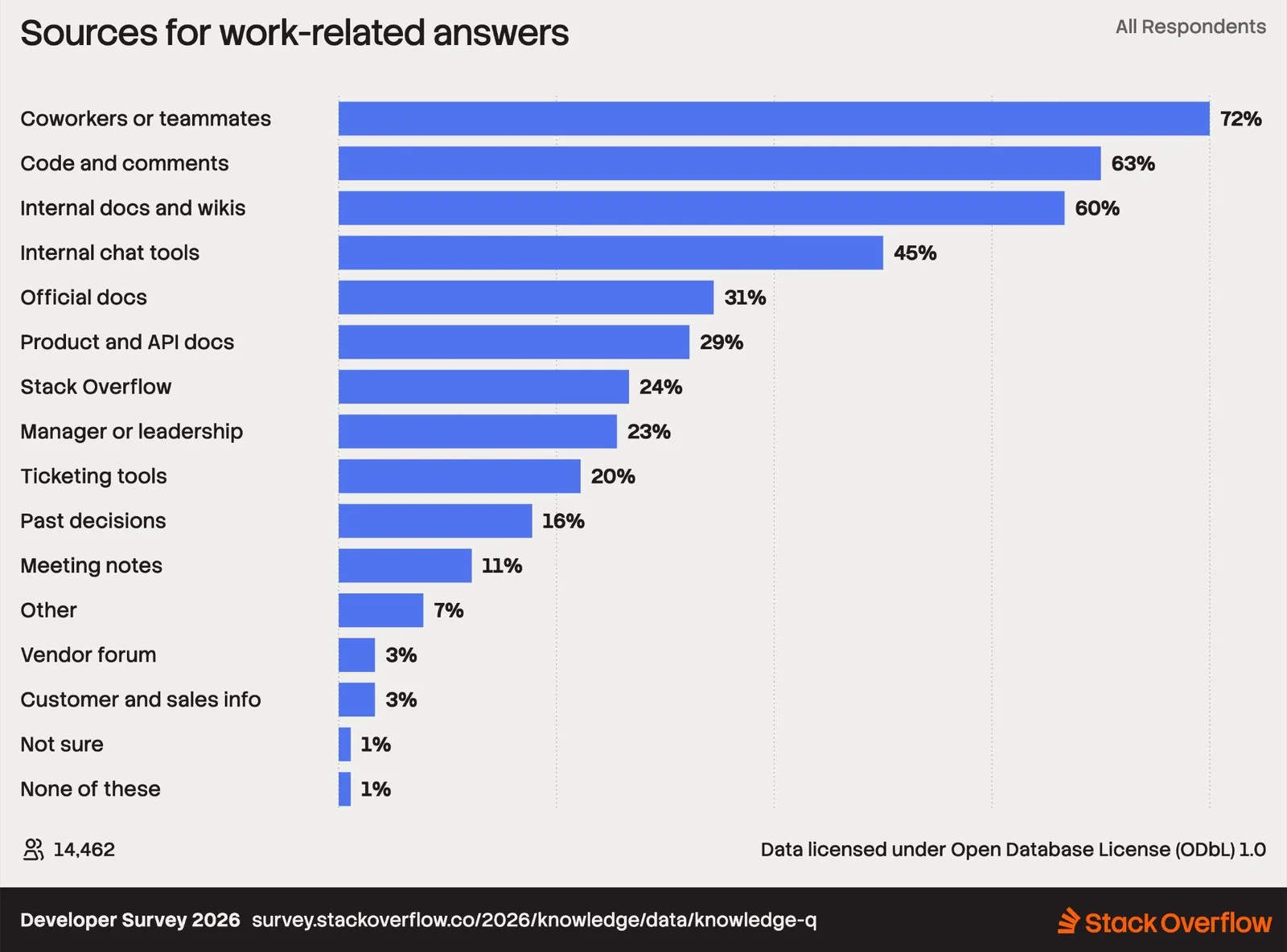
This shows that conversational models have not eliminated the need for specialized, verifiable knowledge.
Source: Developer Survey 2026 — Sources of answers for work.
What does this mean for someone learning to program?
If you're just starting out, artificial intelligence is probably one of the most convenient tools you can use.
You can ask questions without worrying about phrasing them perfectly.
You can ask for explanations tailored to your level and request additional examples.
That makes it easier to get past some early barriers.
But it can also create a problematic dependency.
Imagine you ask an AI to solve all your exercises.
You copy the code, run it and get the expected result.
Did you really learn to solve the problem?
Maybe you learned to use a tool, but that doesn't mean you've developed the necessary fundamentals to understand the program.
That's why I recommend using AI as a learning aid, not just as an automatic answer generator.
A good practice is to ask it to explain why a solution works and what errors could come up.
You can also ask for hints before getting the complete code.
And when you have a problem, check the official documentation and other people's solutions.
Comparing different sources helps you develop judgment.
How to use AI for programming without depending on it completely
These are some practices I find useful.
1. Understand the problem before asking for a solution
If an error appears, first try to identify when it happens.
What were you doing?
What result did you expect?
What changed?
This exercise matters even when you're going to use AI.
A clear description of the problem gets you better answers and helps you understand what you're solving.
2. Ask for explanations, not just code
Instead of writing "fix this", you can ask:
"Explain why this error happens, what alternatives exist and what consequences each solution might have".
This helps you understand the technical decisions.
3. Check the functions and libraries
Models can suggest methods that don't exist or that belong to different versions of a library.
That's why you should check the official documentation.
4. Run tests
A solution is not validated just because the code looks correct.
Test the expected scenarios and also cases that could cause errors.
5. Review changes before accepting them
If you use an assistant that modifies files, examine what changed.
Check that no validations were removed, no permissions were altered and no unnecessary dependencies were introduced.
6. Use Stack Overflow when it adds context
If an AI solution doesn't convince you, look for related questions and review different answers.
Not all older answers will still be correct, but they can help you understand where a problem comes from.
Stack Overflow vs. artificial intelligence: advantages and limitations
| Aspect | Stack Overflow | AI assistants |
|---|---|---|
| Type of answer | Posts written by people | Generated answers |
| Personalized context | Depends on the question | Can adapt to your conversation and files |
| Public discussion | Answers, comments and votes | Usually a one-on-one conversation |
| Freshness | Depends on the community | Depends on access to information and tools |
| Verification | References and community validation | Requires checking sources and results |
| Working across multiple files | Not its main purpose | Possible in supported tools |
| Risk of errors | Incorrect or outdated answers | Plausible errors and unverified code |
Neither option guarantees correct solutions.
The main difference is how the information is obtained and presented.
And for a developer, the most useful thing is probably learning to make the most of both.
The real problem: who will create new knowledge?
This is the question that interests me most.
For years, Stack Overflow worked because thousands of developers shared problems and solutions that could benefit other people.
Some answers became references used for a long time.
But if every problem is solved inside a private conversation with an AI, that knowledge may never end up publicly documented.
This creates a challenge.
AI can make it easier to find answers, but it can also reduce the incentives to share what we've learned.
And when a completely new problem appears, someone needs to investigate it.
For example, a new version of a library may introduce unexpected behavior.
If there is no clear documentation yet, an AI may not have enough information to explain the problem correctly.
In that scenario, human experimentation, bug reports and discussions among developers remain essential.
We don't know exactly how technical communities will evolve.
But we do know that up-to-date, verifiable and well-documented knowledge remains important.
What future awaits Stack Overflow?
There are several possible scenarios.
One is that the number of general questions keeps declining.
Another is that a larger share of activity concentrates on advanced problems or on verifying answers.
It's also possible that the company keeps developing enterprise tools and new ways to leverage its knowledge base.
But these possibilities are scenarios, not confirmed predictions.
The 2026 survey, released by Stack Overflow on October 6, shows that some developers are already using Stack Overflow in a different way.
They may now come to the platform after getting an answer from AI, looking to check its origin or cross-check information.
That suggests technical communities could keep providing value, even if the way people reach them changes.
The challenge will be maintaining enough participation for the knowledge to keep being renewed.
Frequently asked questions
Is Stack Overflow dying?
New-question activity has dropped very significantly, but the platform remains available and retains an extensive library of technical knowledge. That is not the same as saying it has shut down or stopped being useful.
How much did Stack Overflow's activity drop?
Independent analyses of its public API identify a reduction of close to 99% in new monthly questions recorded between November 2022 and October 2026. The figure depends on the methodology and on which questions are still available when the measurement is taken.
Did ChatGPT replace Stack Overflow?
It has replaced part of the use many developers made of Stack Overflow for simple questions, but it has not eliminated its roles in discussion, documentation and public review.
Which is better for learning to program?
It depends on your goals. AI can help you understand concepts and answer questions. Stack Overflow lets you study discussions and solutions shared by other developers. Official documentation and practice remain important.
Is it safe to use AI-generated code?
Not automatically. The code may contain errors, vulnerabilities or incorrect dependencies. You should review and test it before using it, especially in real projects.
Why do programmers keep using Stack Overflow?
To look up historical answers, research specific problems, check information and review explanations offered by other developers.
Can AI learn from Stack Overflow?
Stack Overflow's public content has been relevant to AI initiatives, and the company has announced commercial partnerships related to its technical knowledge. The specific use depends on the relevant sources, licenses and agreements.
Will programming communities disappear?
There isn't enough evidence to say so. Their participation models are changing, but the need to share knowledge, verify solutions and document new problems still exists.
Conclusion: AI did not eliminate the need to learn to program
Stack Overflow is going through a profound transformation.
The data show that many developers no longer use it the same way.
Artificial intelligence tools make it possible to answer questions, explain errors and work directly on entire projects, a change that is also visible in the way websites are built.
That can save time.
But it also introduces a risk: getting used to receiving solutions without understanding them.
Stack Overflow often forced us to read several answers, review comments and understand why a solution worked.
AI can remove part of that process.
And that's an advantage when we need to work faster, but it can be a disadvantage if we stop learning the fundamentals.
My recommendation is not to abandon artificial intelligence or to go back to a way of programming that ignores today's tools.
It's to learn to combine them.
Use AI to explore solutions and speed up tasks.
Consult documentation and communities when you need to verify information.
And above all, develop the ability to recognize when an answer is wrong.
Because the future of programming won't depend only on who can generate code the fastest.
It will also depend on who is able to understand it, fix it and keep it working.
About the author
Rafael Azuaje is a computer engineer with experience in web development and UX/UI design. He shares content about artificial intelligence, automation and technology, with an educational focus aimed at people who want to learn to use digital tools with sound judgment.
Updated on November 18, 2026. Survey results describe their participants; historical question data come from independent analyses based on the public Stack Exchange API.