

A few years ago, when we talked about jobs that machines could replace, we usually thought of factories.
Robots assembling vehicles, machines sorting products and automated systems performing repetitive tasks.
But generative artificial intelligence is introducing a different kind of change.
Now it can do more than automate certain physical or mechanical activities.
It can also write text, generate images, translate documents, analyze information and produce code.
And that means some of the tasks that are changing belong to professions we traditionally considered hard to automate.
Designers, programmers, writers, administrative assistants and customer service professionals are learning to work with tools that can perform part of their duties.
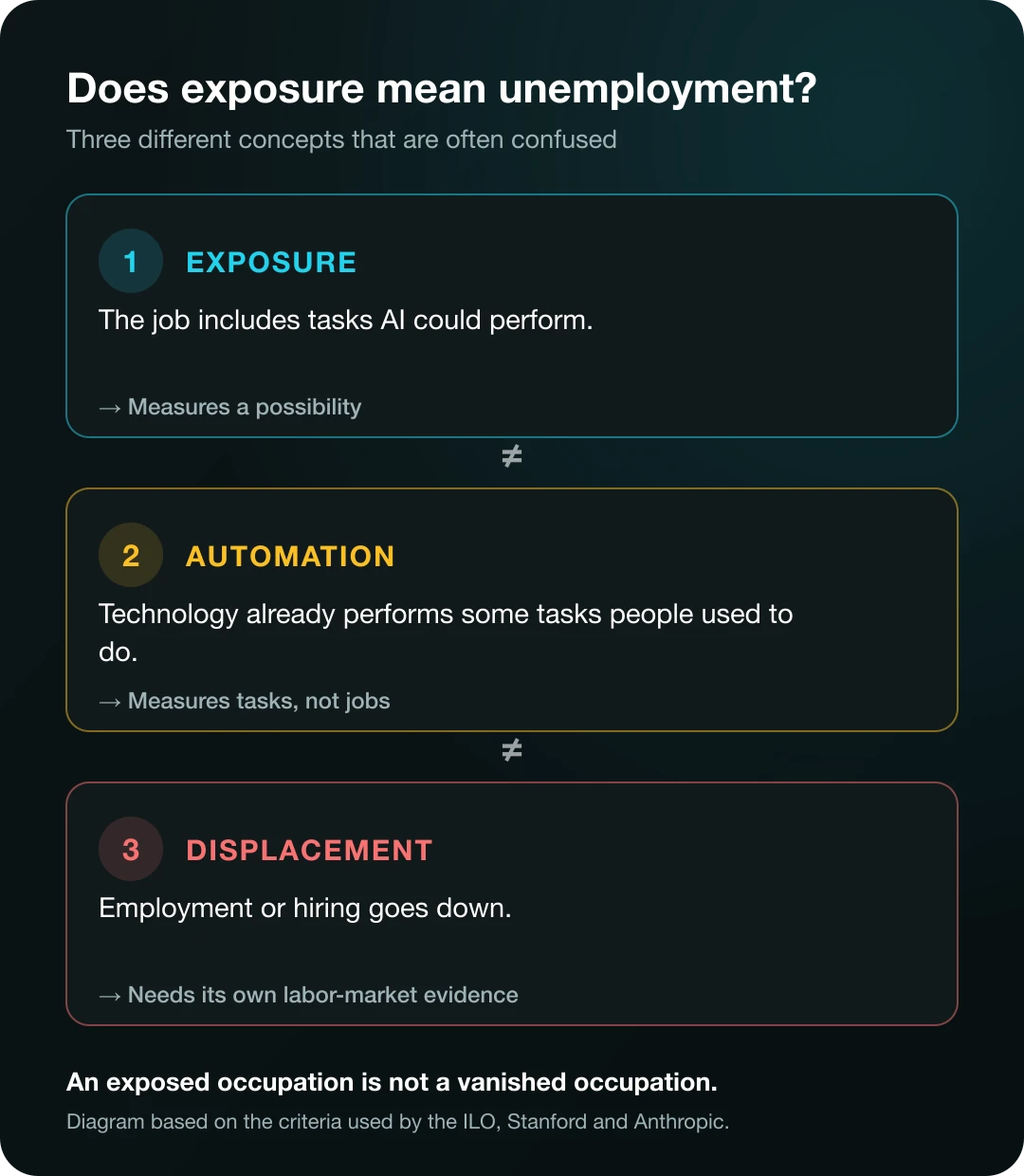
But there is a huge difference between saying that a task can be automated and claiming that a profession has disappeared.
The most recent studies show significant changes, especially in the hiring of young workers. However, there is still not enough evidence to claim that artificial intelligence has caused a mass replacement of all these professions.
So what is really happening?
Let's review the data and the occupations where changes are already being observed.
Is artificial intelligence really taking jobs?
The short answer is that there are signs of displacement in certain segments of the labor market, but no demonstrated widespread substitution.
In May 2025, the International Labour Organization (ILO) published research together with the Polish institute NASK.
The study analyzed nearly 30,000 occupational tasks to estimate which activities could be affected by generative AI.
Its conclusion was that roughly one in four workers worldwide holds an occupation with some degree of exposure to this technology.
But the researchers made a fundamental clarification: the most likely outcome for most occupations is transformation, not disappearance.
Why?
Because jobs rarely consist of a single activity.
A designer doesn't just generate images.
A programmer doesn't just write code.
And someone who works in customer service doesn't simply answer frequently asked questions.
Every profession combines tasks, responsibilities, knowledge and decisions.
Even if AI can automate one part, there may still be activities that require human involvement.
An Anthropic analysis of AI's impact on the labor market reaches a similar conclusion: it found no systematic increase in unemployment among the most exposed workers since late 2022, although it did find signs that hiring of young people has slowed in those occupations.
You can read the International Labour Organization study on generative AI and jobs.

The Stanford data: young people are finding it harder
One of the most important studies on AI's labor impact was published by researchers at the Stanford Digital Economy Lab.
The paper, updated on August 12, 2026, used ADP administrative payroll records covering millions of US workers, with data through June 2026.
The researchers analyzed how employment evolved in occupations with different levels of exposure to artificial intelligence.
Their most striking finding was that employment of workers aged 22 to 25 in highly AI-exposed occupations was roughly 19% below the level it would have reached had it followed the same path as that of young workers in less-exposed occupations.
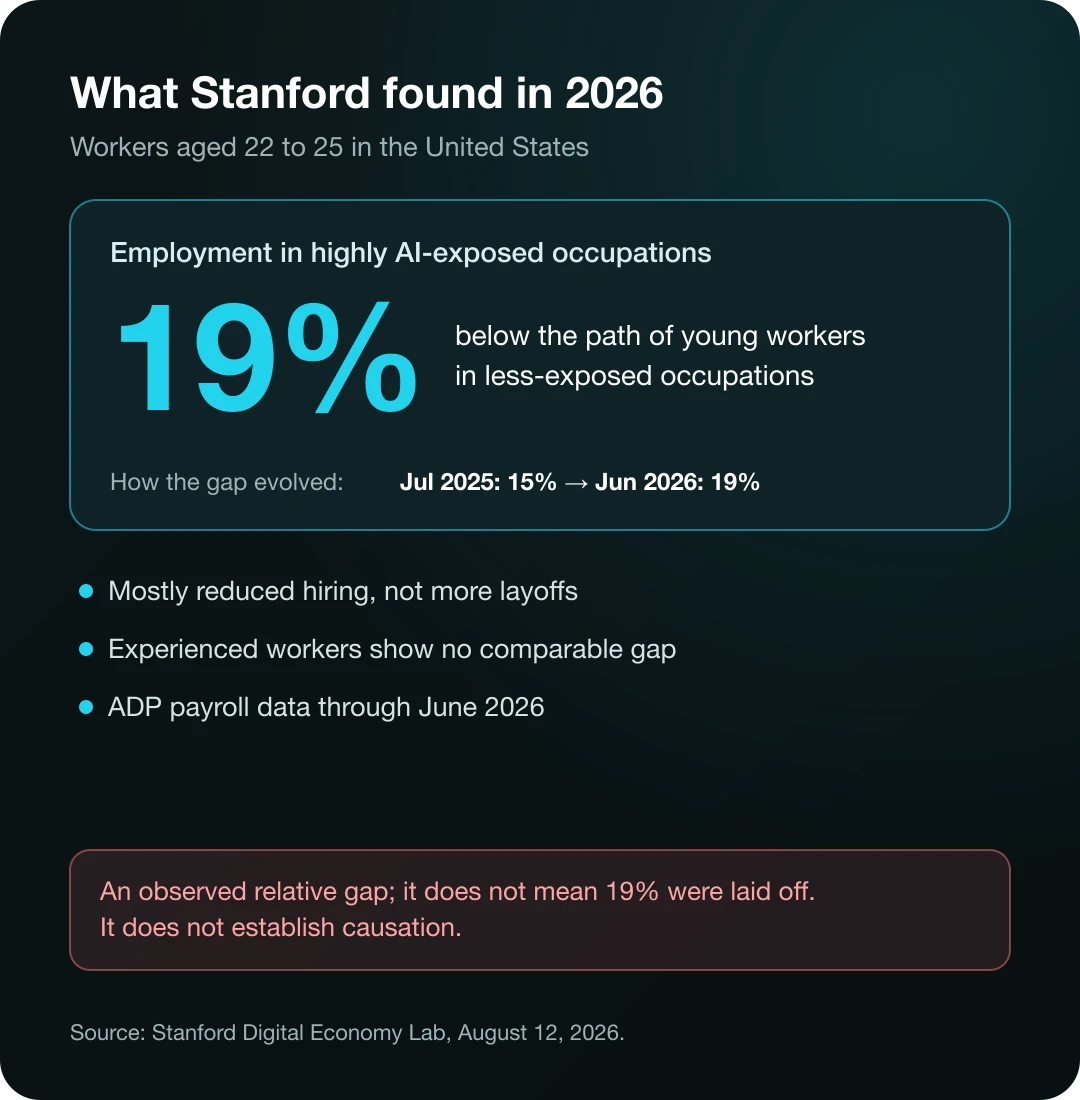
This does not mean that 19% of all young workers have lost their jobs.
Nor does it mean that artificial intelligence alone caused that difference.
It is a relative gap between groups of occupations.
The researchers noted that the pattern appears to be mainly related to reduced hiring of young workers, rather than an increase in layoffs.
They also found that more experienced workers did not show an equivalent difference.
It is important to stress that the study is observational.
Its results are consistent with the possibility that AI is affecting job opportunities for certain profiles, but they do not make it possible to calculate with certainty how many positions were lost solely because of this technology.
Why might entry-level workers be more exposed?
Think about how a career usually begins.
Someone who has just joined a company may handle relatively narrow tasks while learning to solve more complex problems.
A junior programmer might start by fixing simple bugs or building small components.
A designer might adapt existing graphic pieces.
And a marketing assistant might prepare reports or content drafts.
Some of these tasks are precisely the ones AI tools can speed up.
If a company manages to handle part of that work with technology and experienced workers, it could reduce the number of entry-level hires.
This is one possible economic interpretation of the observed changes, not a proven causal explanation for every company. The Stanford Digital Economy Lab itself clarifies that its results are descriptive, not causal estimates.
There is also a long-term problem.
If opportunities for beginners shrink, how will the people who will later need to fill specialized positions gain experience?
It is an important question for companies, universities and professionals.
Eight professional areas where AI is already transforming tasks
The following selection combines occupations with high exposure, automatable tasks and sectors where there are signs of labor changes.
It is not an exact ranking of eliminated jobs.
1. Administrative assistants and data entry staff
Tasks that can be automated include sorting documents, extracting information, preparing simple reports and organizing records.

For example, an AI system can analyze invoices and extract certain fields to prepare them for recording.
It can also sort emails or generate meeting summaries, something some artificial intelligence agents already do.
That reduces the manual work needed for certain activities.
The World Economic Forum identifies several administrative and clerical occupations among those with the largest expected declines by 2030.
In addition, the Anthropic Economic Index from January 2026 found significant coverage of data entry tasks within the observed uses of Claude.
But checks are still needed to correct errors, handle exceptions and verify information.
What's worth learning: advanced spreadsheets, automation, business management tools and data validation.
2. Tier-one customer service
Imagine a company that receives hundreds of questions about opening hours, returns and order status.
Before, each request might have needed an operator's involvement.
Today a conversational system connected to reliable sources can answer some of those inquiries.

It can also sort requests and draft responses.
This lets some teams cut the time spent on frequently asked questions.
In the United States, Stanford's labor market tracking recorded in October 2026 a drop of more than 4% so far this year in employment in AI-exposed occupations, such as software development and customer service. This is data from that country and cannot simply be carried over to other markets.
However, customer service includes situations where an automated answer is not enough.
For example, complex complaints, billing disputes, exceptional requests or sensitive situations.
In these cases, a person's ability to understand the context and solve problems remains important.
What's worth learning: handling complex cases, CRM, automation, incident analysis and supervising virtual assistants.
3. Writers of basic content
Generative AI can produce product descriptions, email drafts and simple informational text.
This changes the commercial value of certain repetitive writing services.
For example, a store that needs initial descriptions for hundreds of products can use AI to prepare drafts.
But it still needs to check features, correct claims and adapt the content to its customers.
Something similar happens with blog articles.
Generating a thousand-word text is no longer especially difficult.
The hard part is researching properly, contributing original information and explaining a topic accurately.
That is why writing work may shift from producing large amounts of text toward researching, editing and verifying.
What's worth learning: research, interviewing, editing, editorial SEO and source verification.
4. Graphic designers focused on repetitive pieces
Generative tools can create illustrations, backgrounds and design proposals.
They also make it possible to carry out visual edits that used to require more manual work.

For example, they can help generate several proposals for a cover or prepare adaptations of a campaign.
However, we must distinguish these tasks from design as a professional discipline.
Building a visual identity requires understanding a brand, its users and the context in which the pieces will be used.
In addition, a generated image may contain errors, breach terms of use or fail to adapt properly to the required formats.
The ILO identified an increase in potential exposure in tasks related to media and web development due to image, audio and video generation capabilities. It is the same shift we analyzed in Is WordPress dead?
That supports the idea that these activities are changing, not that all designers have been replaced.
What's worth learning: art direction, UX/UI, visual identity, accessibility and advanced editing.
5. Junior programmers and repetitive development tasks
Programming deserves special attention because recent labor data exists.
AI tools can generate functions, explain errors, prepare tests and help modify code.

On certain projects, an experienced developer can use them to speed up tasks they would previously have assigned to someone else.
The Stanford study shows signs of lower relative hiring among young workers in highly exposed occupations, and software development is one of the sectors observed.
However, this does not prove that the programming profession is disappearing.
Building software involves architecture, security, requirements, systems integration and maintenance.
In fact, the World Economic Forum projects growth for software and applications developers through 2030.
Both things can happen at the same time: growth in certain occupations and greater barriers to entry for some junior profiles.
What's worth learning: programming fundamentals, data structures, APIs, testing, security and reviewing AI-generated code.
6. Translators of general texts
Machine translation systems have existed for years.
Generative AI has expanded the possibilities for translating, adapting tone and reviewing documents.
This can reduce manual work on simple, low-risk translations.
For example, a company can generate a first version of a commercial description in another language.
But translating is not just about replacing words.
Legal, medical, technical and creative texts may require specialized understanding and human review.
There are also cultural differences that machine translation can misinterpret.
Therefore, the technology may change demand and procedures, but it does not justify claiming that all professional translators are unnecessary.
What's worth learning: sector specialization, localization, linguistic review and computer-assisted translation tools.
7. Transcriptionists and documentation tasks
AI can convert audio to text, identify speakers and generate summaries.
These features are useful for meetings, interviews and certain administrative tasks.
However, transcripts may contain errors with names, figures or specialized terms.
In sensitive areas, such as clinical or legal documentation, verification becomes more important.
The Anthropic report from January 2026 identifies medical transcription among the occupations where some important tasks show high effective coverage in its measurements.
But that is not the same as proving that all transcription jobs have disappeared: the data describes how Claude is used, not confirmed layoffs.
What's worth learning: accuracy review, specialized documentation, privacy and information management.
8. Analysts who produce routine reports
Many companies need periodic reports on sales, inventory, performance or commercial activity.
AI can help interpret tables, identify trends and draft initial explanations.
For example, it can prepare a weekly summary from structured data.
However, an automatically generated report may confuse correlations, use incorrect figures or present conclusions without enough evidence.
An analyst's value is not only in producing charts.
It also includes choosing metrics, understanding the business and explaining which decisions the data can justify.
What's worth learning: SQL, statistics, business analysis, visualization and evaluating results.
Which tasks AI is automating and which need human involvement
| Area | Tasks AI can help automate | Responsibilities that require human review |
|---|---|---|
| Administration | Data sorting and extraction | Validation and exception handling |
| Customer service | Answers to frequent questions | Disputes and sensitive decisions |
| Writing | Drafts and descriptions | Research, accuracy and editorial judgment |
| Design | Variations and graphic assets | Creative direction and brand decisions |
| Programming | Repetitive code and initial tests | Architecture, security and validation |
| Translation | First versions of texts | Context, accuracy and localization |
| Transcription | Speech-to-text conversion | Error correction and confidentiality |
| Analysis | Summaries and initial reports | Interpretation and decision-making |
This table describes common capabilities and responsibilities, not a measurement of eliminated jobs.
Is AI replacing more work than it creates?
We still can't answer that question with a single figure.
In its Future of Jobs Report 2025, the World Economic Forum projected that various economic and technological transformations could create 170 million jobs and displace 92 million by 2030.
That would produce projected net growth of 78 million.
However, these figures include several forces: technology, demographics, the energy transition and economic shifts.
They do not represent the effects of artificial intelligence alone.
In fact, the report specifically attributes to the AI and information processing trend an expectation of approximately 11 million jobs created and 9 million displaced.
These estimates are projections based on employer expectations, not labor outcomes already observed. If you want to see which professions will grow, we cover it in the jobs of the future 2026–2030.
Source: World Economic Forum — Jobs Outlook.
What is happening with employment in Chile?
For those who work in Chile, there is relevant data as well.
An International Monetary Fund report published in 2025 estimated that about 20% of Chilean workers were in occupations with high AI exposure and low complementarity.
This identifies a group potentially more vulnerable to displacement.
However, exposure and risk do not mean that this percentage has lost their jobs.
Nor does it make it possible to predict that exactly 20% of workers will be replaced.
The real impact depends on factors such as investment, training, business structure and the capacity to adopt new technologies.
In addition, US employment patterns will not necessarily be replicated in Chile.
Markets differ in productivity, wages, regulation and sectoral composition.
That is why it makes sense to evaluate international studies alongside the local reality.
Source: IMF — Chile Article IV Consultation, 2025 report.
Should you worry if you work in one of these professions?
Worry shouldn't become a reason to make hasty decisions.
The more useful question is what percentage of your tasks can be automated and what other capabilities you bring.
For example, if you are a designer, you may need to spend less time producing simple variations and more time researching user needs or developing visual systems.
If you are a programmer, you can learn to use coding assistants without losing your understanding of architecture, security and testing.
And if you work in administration, you can learn automation so you supervise processes instead of performing every operation manually.
The important thing is to recognize that tools change the value of certain activities.
A task that used to take several hours may no longer justify the same price or effort.
That can be hard for some professionals, especially those who depend on basic, repetitive services.
But it can also create opportunities to offer more specialized services.
How to prepare if AI is automating part of your job
You don't need to learn twenty new tools right away.
I would start with a simple process.
Step 1. Identify your repetitive tasks
For one week, record which activities you perform most often.
Then sort out which ones require complex decisions and which ones follow clear rules.
Step 2. Try an AI tool
Choose a low-risk task and the right tool for that task.
For example, preparing a first draft of a report from fictitious data.
Check whether you really save time.
Step 3. Evaluate the errors
Generating the result quickly is not enough.
Check whether the tool makes up information or needs too many corrections.
Step 4. Develop complementary skills
If the technology can produce a first version, learn to improve it, verify it and connect it to real needs.
The ILO stresses that the skills mix of each labor market influences whether exposure to AI turns into risk or opportunity.
Step 5. Build demonstrable experience
Prepare projects you can explain.
For example, an automation of a sales process, a data dashboard or a simple application.
Document what you solved, not just which tool you used.
Which professions will be harder to replace?
There is no definitive list of professions immune to AI.
However, activities that combine physical responsibilities, complex human interaction, contextual judgment or high-impact decisions may be harder to automate completely.
For example, a nursing professional doesn't just record information.
They also perform clinical procedures, observe patients and respond to changing situations.
An electrician needs to work physically on real installations.
A teacher doesn't just generate educational content: they also guide learning processes and manage a human environment.
This doesn't mean those professions won't change.
It means that automating some of their tasks is different from replacing all of the work.
The ILO insists that the availability of technology alone is not enough to determine the labor outcome.
Workers' capabilities, how companies are organized and institutional conditions also play a role.
Frequently asked questions
Which jobs is AI replacing in 2026?
There are signs of automation and transformation in administrative tasks, customer service, writing, design, programming, translation and data analysis. But there is not enough evidence to claim that these professions have disappeared completely.
Is artificial intelligence already causing unemployment?
Some studies find signs consistent with reduced hiring in exposed occupations, especially among young workers. However, widespread displacement across the entire economy attributable solely to AI has not been demonstrated.
Will programmers be replaced?
AI can automate certain programming tasks. However, professional development also requires architecture, security, testing and maintenance. The effects may vary by experience level and specialization.
Will AI replace graphic designers?
It can generate images and automate repetitive visual tasks. But professional design includes research, strategy, accessibility and creative decisions that can't be reduced to producing an image.
Which job is most at risk of automation?
There is no single answer that holds for every country. Occupations with large shares of routine, digital tasks may show greater exposure, but the real risk depends on how the technology is implemented and on the labor context.
What does it mean for a job to be exposed to AI?
It means that part of its tasks could be affected by the technology's capabilities. It does not necessarily mean the job will disappear.
Does AI affect young people more?
The Stanford research finds a relative employment gap among US workers aged 22 to 25 in highly exposed occupations. It is early, observational evidence, not a universal conclusion for every country.
What should I learn to protect my career?
It depends on your profession. In general, it can be useful to develop AI literacy, analytical thinking, communication, digital skills and specialized abilities that complement automation.
How many jobs will disappear because of AI before 2030?
There is no confirmed figure. The World Economic Forum projects 92 million jobs displaced by a combination of economic and technological transformations, not by AI alone.
Conclusion: AI is not eliminating every profession, but it is changing their value
For years, many professions were valued for their ability to produce certain results.
Writing a text, designing an image, preparing a report or developing a software component required time and specific knowledge.
Artificial intelligence is reducing the effort needed to carry out part of those activities.
That has real consequences.
It can increase productivity, but it can also change the demand for workers and make it harder for some professionals to enter the market.
The 2026 studies show that what is happening with the hiring of young people deserves special attention.
But they also remind us that automating a task is not the same as eliminating a profession.
My recommendation is not to build your professional future around one specific tool.
Learn the fundamentals of your work and develop the ability to identify problems, evaluate results and make decisions.
Use AI when it adds value, but don't give up understanding what you are doing.
Because the most important change is not that a machine can produce something in seconds.
It's that we will have to rethink which knowledge, decisions and responsibilities make our work truly valuable.
About the author
Rafael Azuaje is a computer engineer with experience in web development and UX/UI design. He shares educational content about artificial intelligence, automation and technology, with the goal of helping people who are starting to use digital tools to do so with sound judgment.
Updated on November 18, 2026. The studies cited distinguish between potential exposure, observed activity, statistical associations and projections. None of these categories should automatically be interpreted as layoffs caused by AI.