
What if the career you're studying for today changes completely before you even graduate?
It's not as far-fetched a question as it sounds.
Artificial intelligence is already changing how we write code, design, analyze information and serve customers. Some tasks that used to take hours can now be done in minutes.
But something tends to get lost among so many headlines about disappearing jobs: technology is also creating opportunities.
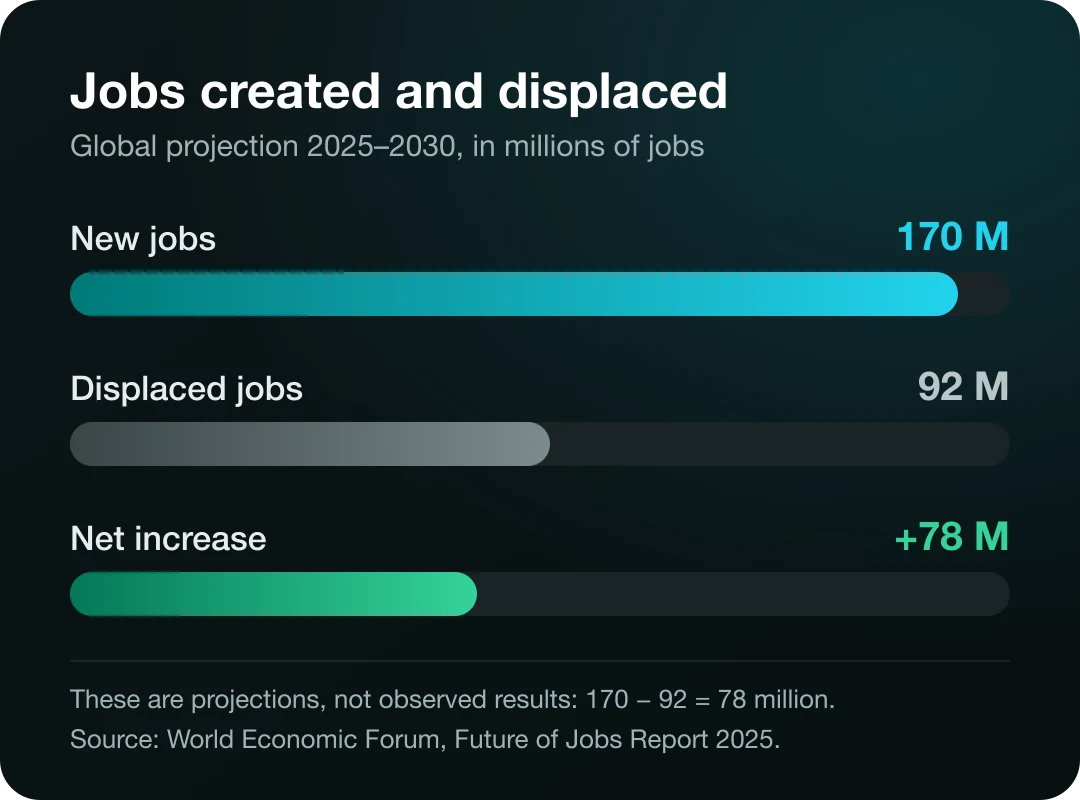
According to the World Economic Forum's Future of Jobs Report 2025, changes in the labor market could create 170 million new jobs between 2025 and 2030, while another 92 million would be displaced.
The projected result would be a net increase of 78 million jobs.
That doesn't mean everyone who loses a job will automatically find a new one. Emerging jobs may call for different skills and may be in other sectors or regions.
So which jobs will be most in demand? Which ones are changing? And, above all, what's worth learning if you want to be ready for the years ahead?
Let's look at the trends with data, without promising that any career will be immune to automation.
What will the job market look like in 2030?
To understand the future of work, we need to look beyond artificial intelligence.
The World Economic Forum identifies five major forces transforming work: technological progress, geoeconomic fragmentation, economic uncertainty, demographic shifts and the transition to a greener economy.
Each one creates different needs.
For example, an aging population can increase demand for health and care professionals. Electrification and renewable energy need technicians, engineers and maintenance staff.
At the same time, the digitalization of businesses increases the need for professionals who can run systems, protect information and build applications.
That's why the future of work won't be made up only of programmers and AI engineers.
There will also be opportunities in education, logistics, construction, energy and health.
In fact, the World Economic Forum report distinguishes between the jobs that would grow fastest in percentage terms and those that would create the largest number of positions in absolute terms.
That difference matters.
A relatively small tech profession can double its demand and top a percentage-growth ranking, while a much more traditional occupation can create millions of new positions without growing at the same pace.
You can see this distinction in the Jobs Outlook section of the Future of Jobs Report.
The 10 jobs of the future with the most potential between 2026 and 2030
The selection below combines professions listed among the World Economic Forum's fastest-growing occupations with areas that offer significant job opportunities.
It isn't an exact ranking of the ten professions that will hire the most, nor does it guarantee jobs or high salaries.
It's a guide to spotting sectors where building skills is worth it.
1. Artificial intelligence and machine learning specialist
This is one of the occupations most closely tied to today's technological shift.
These professionals build, adapt and evaluate systems that can process information, recognize patterns and generate predictions or content.
For example, a company might need a system that analyzes documents, sorts requests or helps detect unusual behavior in transactions.
It's not just about writing prompts for a chatbot.
The work can include programming, preparing data, evaluating models, integrations and monitoring how they perform.
What's worth learning: Python, machine learning fundamentals, data handling, APIs, model evaluation and security principles.
Do you need a university degree? Some specialized roles do require advanced studies. In others, proven experience and hands-on projects can open doors, although they don't replace every requirement in the market.
2. Big data and data engineering specialist
Companies generate enormous amounts of information.
But storing data doesn't mean they can use it well.
That's where the specialists who design systems to collect, organize, transform and process information come in.
Picture an online store that records sales, visits, inventory and customer behavior.
To analyze that data, it first needs it to be available, properly structured and reliable.
The World Economic Forum places big data specialists among the occupations with the highest projected percentage growth toward 2030.
What's worth learning: SQL, Python, databases, ETL/ELT processes, cloud tools and data quality fundamentals.
A good way to start is to build a project that pulls information from a public source, organizes it in a database and produces verifiable indicators.
3. Cybersecurity specialist
We rely more and more on apps, cloud services and connected devices.
That also widens the risks.
Companies need to protect accounts, systems, networks and sensitive information.
A cybersecurity specialist might analyze vulnerabilities, manage identities, review configurations, respond to incidents or design preventive controls.
Security isn't only about learning to find flaws in an application.
It also means understanding how systems work and assessing what could go wrong.
The World Economic Forum report lists both information security analysts and security management specialists among the occupations with notable growth prospects.
What's worth learning: networking, Linux, application security, identity management, cloud fundamentals and incident response.
Before studying attack tools, it's worth mastering networks, operating systems and good defensive practices.
4. Software and applications developer
You've probably heard that artificial intelligence will end up replacing programmers.
But the situation is a good deal more complex.
Today there are tools that can generate code, explain errors and help build applications. That's changing developers' work.
Still, building useful software requires understanding requirements, designing solutions, managing data, integrating services, testing and maintaining systems.
The World Economic Forum includes software and applications developers among the fast-growing occupations toward 2030.
That doesn't guarantee every profile or level of experience will see the same demand.
My advice is not to learn programming as an exercise in memorizing syntax.
What's worth learning: programming fundamentals, JavaScript or Python, databases, APIs, version control, testing and basic software architecture.
It's also important to learn to use coding assistants without relying on them completely.
Being able to tell when generated code is wrong becomes especially valuable.
5. Financial technology (FinTech) engineer
Financial apps, digital payments and modern banking services need specialists who can combine software skills with financial processes.
A FinTech engineer might work on payment platforms, banking integrations, fraud prevention systems or financial management apps.
It's a prominent occupation in the World Economic Forum's projections.
But that doesn't mean you have to become an expert in every area of finance.
Many of these roles call for specializing in one specific kind of product.
What's worth learning: backend development, APIs, databases, security, payment processing and the basics of the applicable regulation.
To get started, you can build a simulation app that records fictitious transactions and produces reports, without using real money or storing sensitive financial data.
6. Renewable energy specialist
Not every job of the future depends on AI.
The expansion of renewable energy and electrification is creating needs in design, installation, operation and maintenance.
Engineers and technicians can work on solar and wind systems, energy storage and electrical infrastructure.
The World Economic Forum identifies renewable energy engineers and specialists tied to the energy transition among the occupations with favorable prospects.
What's worth learning: electrical fundamentals, energy systems, efficiency, maintenance and safety.
In this sector, many roles require technical or professional training, certifications and compliance with local regulations.
7. Electric and autonomous vehicle specialist
Electric vehicles combine electronic systems, batteries, software and diagnostic technologies.
Their expansion calls for professionals who can design components, analyze data, carry out maintenance and test systems.
Autonomous vehicles add challenges around sensors, perception of the surroundings, safety and software.
However, the sector's projected growth shouldn't be confused with universal, immediate adoption of self-driving.
What's worth learning: electronics, electrical systems, batteries, embedded programming and safety protocols.
You don't need to start by building an autonomous vehicle. You can explore educational projects in electronics, sensors and control.
8. Nursing and healthcare professionals
This is one of the areas that shows why the future job market can't be reduced to technology.
An aging population and healthcare needs drive demand for health and care professionals.
In its report, the World Economic Forum projects growth for nursing roles and other occupations related to caring for people.
Technology can help through documentation, analysis and monitoring tools, but many of these roles require in-person care, clinical skills, empathy and professional responsibility.
What's worth learning: it depends on the profession; university or technical studies, accreditation, clinical training and ongoing education may be required.
AI could become an additional tool for these professionals, not necessarily their replacement.
9. Teachers and training specialists
If the skills companies need are changing, someone will have to help people develop them.
The World Economic Forum also projects growth in certain teaching occupations, including higher and secondary education.
On top of that, lifelong learning will matter for workers who need to adapt to new tools.
This can create opportunities in formal education, corporate training and technical upskilling.
What's worth learning: pedagogy, communication, learning experience design, assessment and digital tools.
Knowing a subject isn't enough. Teaching requires understanding how people learn and how to check whether they've really acquired a skill.
10. Logistics and digital operations specialist
E-commerce and supply chains need to move products, manage inventory and coordinate deliveries.
Although many logistics roles are still physical, digital systems are changing how they operate.
Specialists can use analytics, planning and automation tools to improve processes.
The World Economic Forum projects considerable growth in delivery-related occupations and other roles in the real economy.
That's why I include logistics in this selection, especially combined with digital tools.
What's worth learning: inventory management, spreadsheets, data analysis, ERP systems, automation and operations fundamentals.
A hands-on project could be building a dashboard that shows pending orders, dispatch times and issues using test data.
Which jobs will grow fastest?
According to the World Economic Forum's projections for 2025–2030, the occupations with the highest expected percentage growth include the following:
| Occupation | Area |
|---|---|
| Big data specialists | Data |
| FinTech engineers | Financial technology |
| AI and machine learning specialists | Artificial intelligence |
| Software and applications developers | Development |
| Security management specialists | Security |
| Storage and autonomous vehicle specialists | Mobility and energy |
| Electric and autonomous vehicle specialists | Mobility |
| UI and UX designers | Digital design |
| Delivery drivers | Logistics |
| Internet of Things specialists | Connected technology |
This table lists occupations highlighted in the report; the order here shouldn't be read as an exact ranking by growth rate.
Source: WEF — Jobs Outlook 2025–2030.
Which jobs could lose demand by 2030?
Not every occupation has the same prospects.
The World Economic Forum identifies certain administrative and routine roles among those expected to decline the most.
They include cashiers and ticket clerks, administrative assistants, executive secretaries, printing workers and certain data processing clerks.
What do they have in common?
Many of their tasks can be standardized, digitized or automated through software, self-service systems or artificial intelligence.
For example, entering data from structured documents is an activity that can be partly automated.
But that doesn't mean every administrative employee is going to disappear.
Someone who coordinates operations, solves complex problems and manages relationships may do very different work from someone who only enters information.
Exposure to automation depends on the tasks, not just on the job title.
Is artificial intelligence really replacing jobs?
This question deserves a careful answer.
In May 2025, the International Labour Organization and the Polish research institute NASK published a study on how exposed occupations are to generative AI.
Their conclusion was that roughly one in four jobs worldwide showed some degree of exposure to this technology.
But the researchers also noted that tasks being transformed was a more likely outcome than most jobs being replaced outright.
You can read the study at the International Labour Organization.
It's important to understand what exposure means.
An occupation being exposed to AI doesn't mean it has been eliminated, that it will necessarily disappear or that all of its tasks can be automated.
It means certain activities could be affected by what the technology can do.
Think of a graphic designer.
AI can generate images, propose layouts and speed up revisions.
But defining a coherent visual identity, understanding the client, assessing accessibility and making design decisions still require other abilities.
That doesn't guarantee job security for every designer. It does show that judging a profession by a single automated task can lead to the wrong conclusions.
The same goes for programming, writing, marketing and customer service.
What LinkedIn's latest 2026 data says
There's another interesting indicator.
On October 27, 2026, LinkedIn published new data on how professional hiring is changing.
According to its analysis, AI has helped create roughly two million new jobs.
It also identified AI engineers among the ten fastest-growing occupations in seven major economies over July–September 2026.
Another figure stands out: the share of job postings asking for general AI skills rose by roughly 65% over the previous twelve months.
This suggests AI-related skills don't only matter to people who want to become specialized engineers.
They're also starting to show up in postings for other professional areas.
However, LinkedIn notes that opportunities aren't evenly distributed.
Education, location and access to employers still shape people's chances of being hired.
Also, its statistics come from its own network and methodology, so they don't automatically represent the entire global labor market.
Source: LinkedIn — Where Opportunity Is Emerging as Work Changes, October 2026.
The most important skills for work in 2030
Choosing a profession matters, but building adaptable skills can be even more useful.
The World Economic Forum estimates that, on average, 39% of workers' current skills will change or become outdated between 2025 and 2030.
That doesn't mean 39% of people will lose their jobs.
It means employers expect major changes in the knowledge needed to do the work.
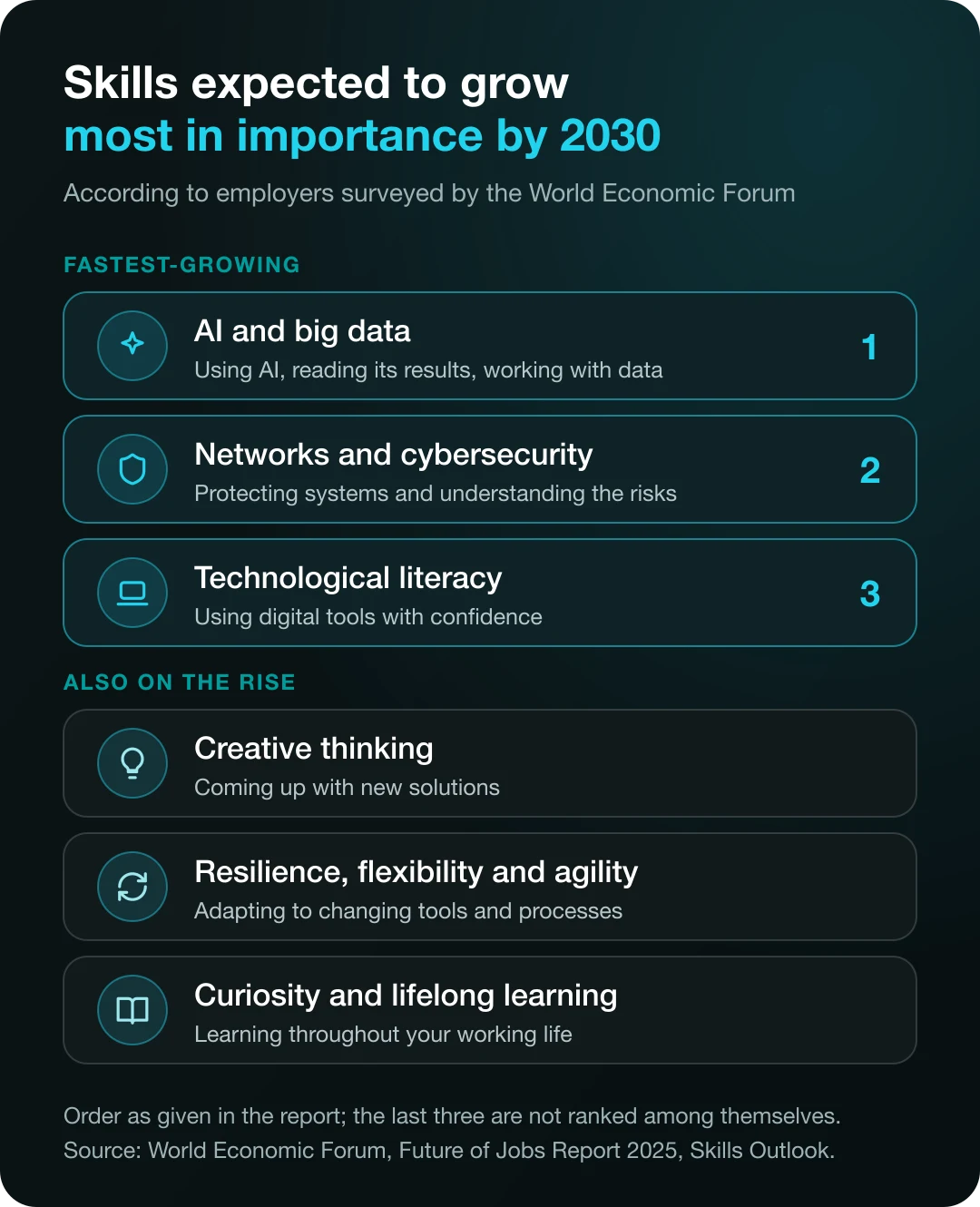
Among the skills expected to grow most in importance:
Artificial intelligence and data analysis. Understanding how to use AI systems, read their results and work with information.
Networks and cybersecurity. Protecting systems, understanding risks and managing technology safely.
Technological literacy. Using digital tools with confidence and understanding what they can and can't do.
Creative thinking. Coming up with new solutions and approaching problems from different angles.
Resilience, flexibility and agility. Adapting to changing tools, processes and conditions.
Curiosity and lifelong learning. Staying willing to learn throughout your working life.
Analytical thinking, leadership and the ability to work with other people also appear among the relevant skills.
You can read the original analysis in the WEF — Skills Outlook.
What's interesting is that not all of these skills are technical.
Knowing how to code can open doors, but so does the ability to identify a problem, communicate and judge whether a solution works.
What should I study today if I want opportunities in 2030?
It depends on your interests and on where you are right now.
If you like solving technical problems, you could explore software development, data engineering or cybersecurity.
If you're interested in working with people, health and education also offer significant opportunities.
And if you enjoy combining business processes with technology, you can explore automation and operations analysis.
My advice is to avoid choosing a career just because it shows up on a list of the most in-demand.
Before making a decision, look into three things.
First, what someone in that field actually does day to day.
Second, what the entry requirements are and what opportunities exist in your region.
And third, whether you'd be willing to put in the time to build those skills.
A profession can have excellent global prospects and still offer few entry-level openings in a given city.
That's why international rankings are a reference, not a substitute for researching your local market.
How to prepare for the future of work without starting another degree
Not every career change requires studying for a new degree.
In many areas you can start by building skills that complement your current experience.
For example, someone working in administration can learn data analysis and automation.
A marketing professional can study AI tools, research and campaign measurement.
Someone in logistics can learn to use inventory systems and build reports.
What matters is connecting what you already know how to do with the new tools.
Step 1. Pick one specific skill
Instead of saying "I want to learn artificial intelligence," define what you want to achieve.
For example: "I want to automate sorting the requests that land in my inbox."
That turns an intention that's too broad into a goal you can work on.
Step 2. Learn the fundamentals
Use official documentation, courses and hands-on exercises.
You don't need to master ten tools at once.
It's better to understand one technology and its limits before adding others.
Step 3. Build a project
Projects let you show that you can apply what you've learned.
You could build a small website, a data dashboard or an automation that solves a real need.
Document the problem, the tools you used, the results and the limitations.
Step 4. Learn to evaluate AI output
If you use artificial intelligence tools, don't just accept their answers.
Check the data, review the code and understand the important decisions.
A valuable skill will be recognizing when a convincing-looking answer is wrong.
Step 5. Keep your knowledge up to date
Tools change quickly.
That's why it pays to build a habit of continuous learning, rather than relying on a single course that promises to prepare you for the whole decade.
Is it worth learning to code if AI already writes code?
Yes, as long as you're interested in building software and understanding how it works.
AI can help you write code, find bugs and speed up tasks.
But someone still has to decide what to build, check that the program works, protect the data and maintain the application when requirements change.
Learning to program isn't just memorizing commands.
It also means breaking down problems, understanding systems, designing solutions and checking results.
Even if you use assistants that generate much of the code, that knowledge helps you catch important mistakes.
That said, opportunities for junior developers may shift as these tools are adopted.
That's why it's worth combining solid fundamentals with real projects and learning to work productively with AI.
What are the jobs of the future for people who can't code?
There are plenty of options.
Education, nursing, care, energy systems maintenance and various logistics roles require skills that don't depend mainly on programming.
There are also opportunities for professionals who combine experience in a sector with digital skills.
For example, someone who knows a company's processes can help put automation tools in place without building every system from scratch.
However, not knowing how to code doesn't mean you can ignore technology altogether.
Knowing how to use digital tools, protect information and evaluate results will be useful in a wide range of occupations.
Frequently asked questions about the jobs of the future
What will be the most in-demand jobs in 2030?
According to the World Economic Forum's projections, the occupations with the highest percentage growth include big data specialists, FinTech engineers, AI specialists, software developers and certain security roles.
In terms of the absolute number of new positions, delivery, farming, care and education roles also stand out.
Which profession will be the best paid in 2030?
There's no reliable answer for every country.
Salaries depend on experience, specialization, region, company and market conditions.
A fast-growing sector doesn't guarantee that all its professionals will earn high salaries.
Will AI eliminate programmers?
There isn't enough evidence to say the whole profession will disappear.
AI is automating certain programming tasks and may change the demand for different profiles.
At the same time, the World Economic Forum's projections still include software development among the growing occupations.
Which jobs are least at risk of automation?
Occupations that require complex human interaction, in-person responsibilities, varied physical skills or context-dependent decisions may be harder to automate completely.
Still, no profession should be considered fully immune to technological change.
What should I learn first: artificial intelligence or programming?
It depends on your goal.
If you want to use AI tools to improve your work, you can start with AI literacy and basic automation.
If you want to build applications or create advanced integrations, learning programming fundamentals will give you a stronger base.
Is it too late to change careers?
There's no universal age after which changing careers becomes impossible.
But a transition means weighing time, resources, personal commitments and real opportunities.
It's often more practical to build complementary skills before leaving your current work entirely.
Conclusion: the future of work doesn't belong only to those who can use AI
Artificial intelligence is changing the job market, but it isn't the only force that will decide which professions grow over the coming years.
Digitalization, an aging population and the energy transition are also creating new needs.
The data shows opportunities in technology, health, education, energy and other essential activities.
My advice is not to try to guess which profession will be the most popular four years from now.
It's more useful to build skills that let you adapt.
Learn to use new tools, but also to question their output. Understand problems before trying to automate them. And look for opportunities where your experience can be combined with new knowledge.
Because preparing for the future of work doesn't mean learning every technology that appears each week.
It means developing the judgment to know which ones are worth learning and how to use them to solve real problems.
About the author
Rafael Azuaje is a computer engineer with experience in web development and UX/UI design. He shares educational content on artificial intelligence, automation and technology, aiming to help people who are just starting out understand digital tools and use them with good judgment.
Editorial update: November 17, 2026.
Main sources
- World Economic Forum — The Future of Jobs Report 2025.
- World Economic Forum — Jobs Outlook and Skills Outlook.
- International Labour Organization — Generative AI and Jobs, 2025.
- LinkedIn — Where Opportunity Is Emerging as Work Changes, October 2026.