
Imagine you visit a well-known website.
It could be a news outlet, a video-calling platform or the site of an international company.
The address is correct. You haven't received any suspicious link, and you aren't visiting a fake copy.
Even so, your browser could run malicious code.
That is exactly what made the security incident involving Optimizely on November 16, 2026 so worrying.
The attackers didn't need to directly modify the servers of each of the organizations identified. They exploited a vulnerability in a third-party service those companies used to optimize their websites.
Through that service, they managed to inject malicious JavaScript that could run when someone visited certain sites.
According to research by Report URI, 188 tampered scripts belonging to 178 organizations were identified.
Among the names detected were BBC, CNN, Zoom, Salesforce, GitLab, IKEA and Equifax.
But there is something we need to make clear from the start: finding a malicious script associated with an organization does not mean that all of its users had their information stolen.
Nor does it mean that those companies' internal servers were compromised.
To understand what happened, we need to know how the third-party services we use every day on the Internet work.
What is Optimizely and what is it used for?
Optimizely is a digital experience platform that companies use to improve, personalize and test certain features of their websites.
One of its tools is Web Experimentation.
It lets you run A/B tests, a method that consists of showing different versions of a page to see which one performs better.
Imagine a store wants to know which button generates more purchases.
It can show a blue button to some of its visitors and a green one to others.
Then it compares the results.
This helps make decisions based on users' observed behavior.
To implement certain experimentation features, the site may load a JavaScript file provided by Optimizely.
That file runs in the visitor's browser and makes it possible to apply changes or record interactions.
Up to this point, everything is part of how many web tools normally work.
The problem arises when an attacker manages to modify the contents of that file.
Because if the site trusts it, it could run malicious instructions without its administrators having made those changes themselves.
What happened with Optimizely on November 16, 2026?
The incident began with the exploitation of a vulnerability in the account signup process of Optimizely Web Experimentation.
According to the company's official report, an unauthorized third party exploited that flaw to impersonate users with administrative privileges within certain projects.
This made it possible to modify a section known as Project JavaScript.
That section contains code that can run on pages where the Web Experimentation script is installed.
The attackers inserted malicious instructions into projects belonging to different customers.
As a result, pages that loaded the affected scripts could run that code in their visitors' browsers.
In its November 17 report, Optimizely confirmed that this was not a password leak.
The attacker managed to impersonate permissions through a flaw in the system, without needing to obtain the administrators' credentials.
The company also confirmed that the incident was limited to Web Experimentation, and reported it on its service status page.
It found no indication that Feature Experimentation, its SDKs or its legacy Full Stack product were compromised in this incident.
Official source: Optimizely — Initial incident report, November 17, 2026.
How could a single flaw affect so many companies?
This is the most important part of the story.
Many companies bring in external resources to provide certain features.
For example, they use tools to analyze traffic, display maps, run marketing tests or manage forms.
In some cases, those services add JavaScript files directly to the pages.
Normally, the browser downloads those files from the provider's servers.
And once loaded, they can have access to important parts of the page they run on.
In Optimizely's case, the tampered scripts were still being served from the service's legitimate infrastructure.
That made the file's address look completely normal.
Visitors could be on a genuine site, using a valid HTTPS connection and loading a resource from a well-known provider.
But the script's contents had been modified.
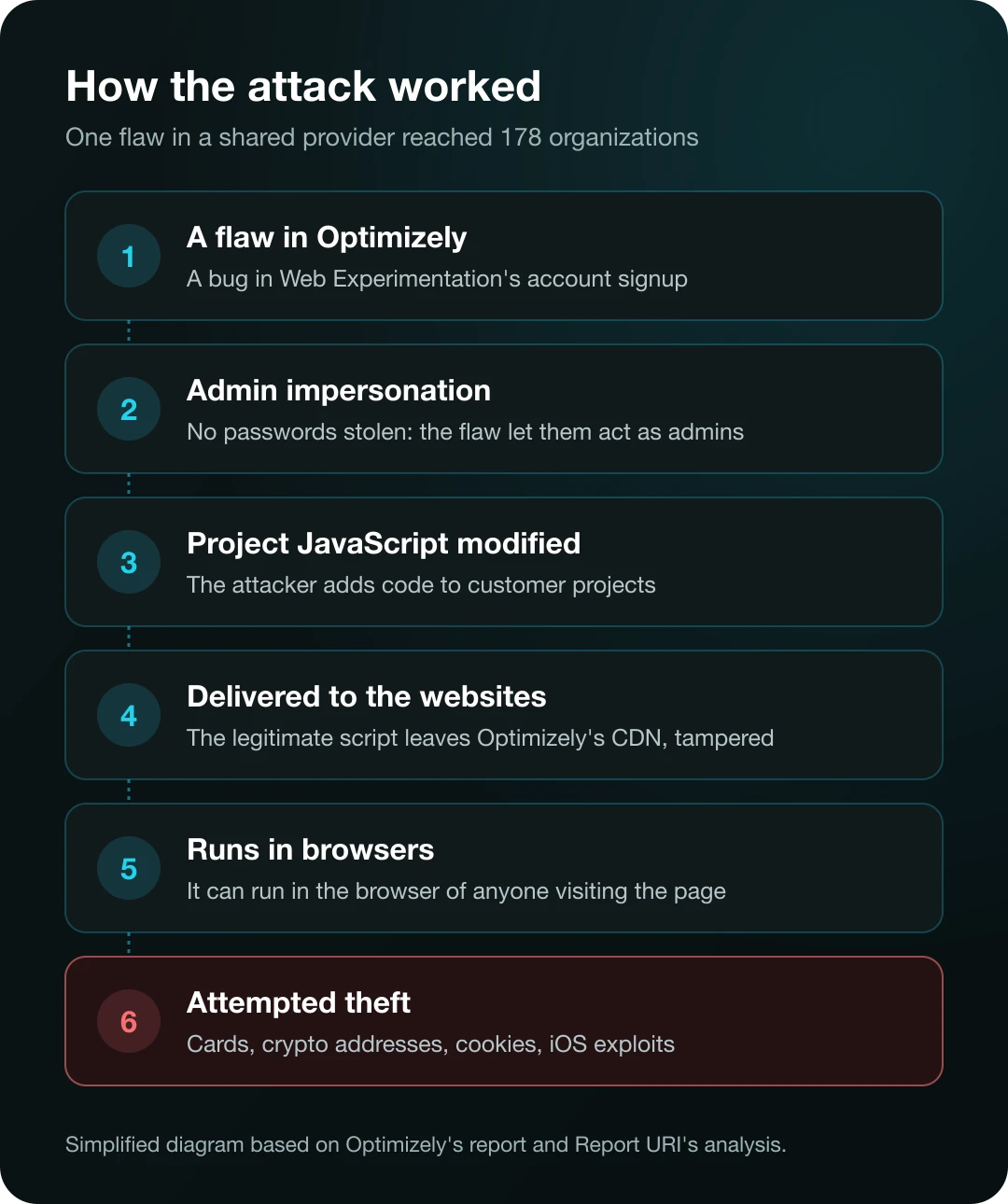
This situation is known as a software supply chain attack, or supply chain attack for short.
Instead of attacking each organization individually, the criminal compromises a shared component used by different companies.
The potential impact can multiply quickly, as security journalist Brian Krebs explains in his analysis of the incident.
The 178 organizations identified: which ones appeared in the research?
Security researcher Scott Helme, of Report URI, published a detailed analysis of the incident on November 16.
In its review of 1,611 Optimizely scripts, its team found malicious code in 186; in total, it identified 188 tampered scripts.
Those files were associated with 178 organizations.
The companies and entities mentioned in the research included:
- BBC and CNN, in the media sector.
- Zoom and GitLab, in the technology sector.
- Salesforce, an enterprise software provider.
- IKEA, in retail and home furnishings.
- Equifax and certain HSBC operations, in financial services.
- Air France-KLM, in air transport.
- Ledger, in the cryptocurrency ecosystem.
Tampered scripts associated with Optimizely's own sites were also observed.
It is important to interpret this information correctly.
Detecting a compromised script does not, on its own, prove a database leak, access to corporate networks or the loss of information belonging to all of those organizations' customers.
Some companies carried out their own investigations and, according to Reuters, said they had found no evidence of unauthorized access to their systems or data.
That is why it is more accurate to speak of organizations whose sites or scripts were identified in the exposure, rather than claiming that all of them suffered a confirmed theft.
Source: Scott Helme — World's Largest Brands Infected With Malware Via Optimizely.
What did the malicious code do?
The research found several functions intended to carry out harmful activity inside the browser.
Not all of them were necessarily triggered for every visitor.
The behavior depended on the device, the page and the actions the person took.
1. It tried to steal payment card data
One of the functions detected was a card skimmer.
It is a program designed to capture card data when a person enters it into certain forms.
For example, it could look for card numbers, expiration dates and security codes in forms accessible from the page.
The program would then try to send that information to infrastructure controlled by the attackers.
However, there is an important difference between typing the data directly into a form on the page and doing so in a form hosted in isolation by a payment provider.
Optimizely explained that fields protected by certain hosted payment iframes, such as those used by Stripe or Adyen, were out of reach of the identified script.
That does not mean any payment integration is automatically secure.
It means that the form's architecture significantly affects the exposure.
2. It could swap cryptocurrency addresses
Another function looked for cryptocurrency wallet addresses within certain content and interactions.
The goal was to replace a legitimate address with one controlled by the attacker.
Imagine you are making a transfer.
You copy the address of the person who will receive the money and paste it into the corresponding app.
If a malicious program changes that address without you noticing, you could end up sending funds to someone else.
The research found evidence of transactions received by addresses associated with the malicious code.
But not all the money recorded in those wallets can be conclusively attributed to the Optimizely attack because, as BleepingComputer pointed out, some of them already showed prior activity.
So it would not be correct to publish a definitive figure for the money stolen without stronger attribution.
3. It tried to obtain information from the browser
The researchers also found functions related to collecting data from the browsing context.
Under certain circumstances, the code could try to obtain information such as the page URL, cookies readable through JavaScript and screenshots.
That does not mean it could read any cookie or freely access all the data on a device.
Browser restrictions, cookie attributes and the protections implemented by the site determine what information may be available.
4. It tried to run attacks against iPhone and iPad
One of the most worrying findings was the presence of components targeting iOS and iPadOS devices.
Report URI identified code associated with exploitation tools known as Coruna and DarkSword.
These tried to exploit vulnerabilities in certain versions of the operating system.
Optimizely's official report noted that the second stage targeted versions 18.6 and earlier.
Reuters also reported statements from Apple indicating that the targeted vulnerabilities had already been fixed in earlier updates.
It is important not to confuse an exploitation attempt with confirmation that every exposed device was compromised.
To reduce the risk, the recommendation is to keep iOS and iPadOS up to date.
Sources: Report URI's technical investigation and Reuters — Websites compromised through Optimizely.
Official timeline of the attack
Optimizely published a preliminary timeline that makes it possible to reconstruct the main events of November 16, 2026.
All times are in UTC.
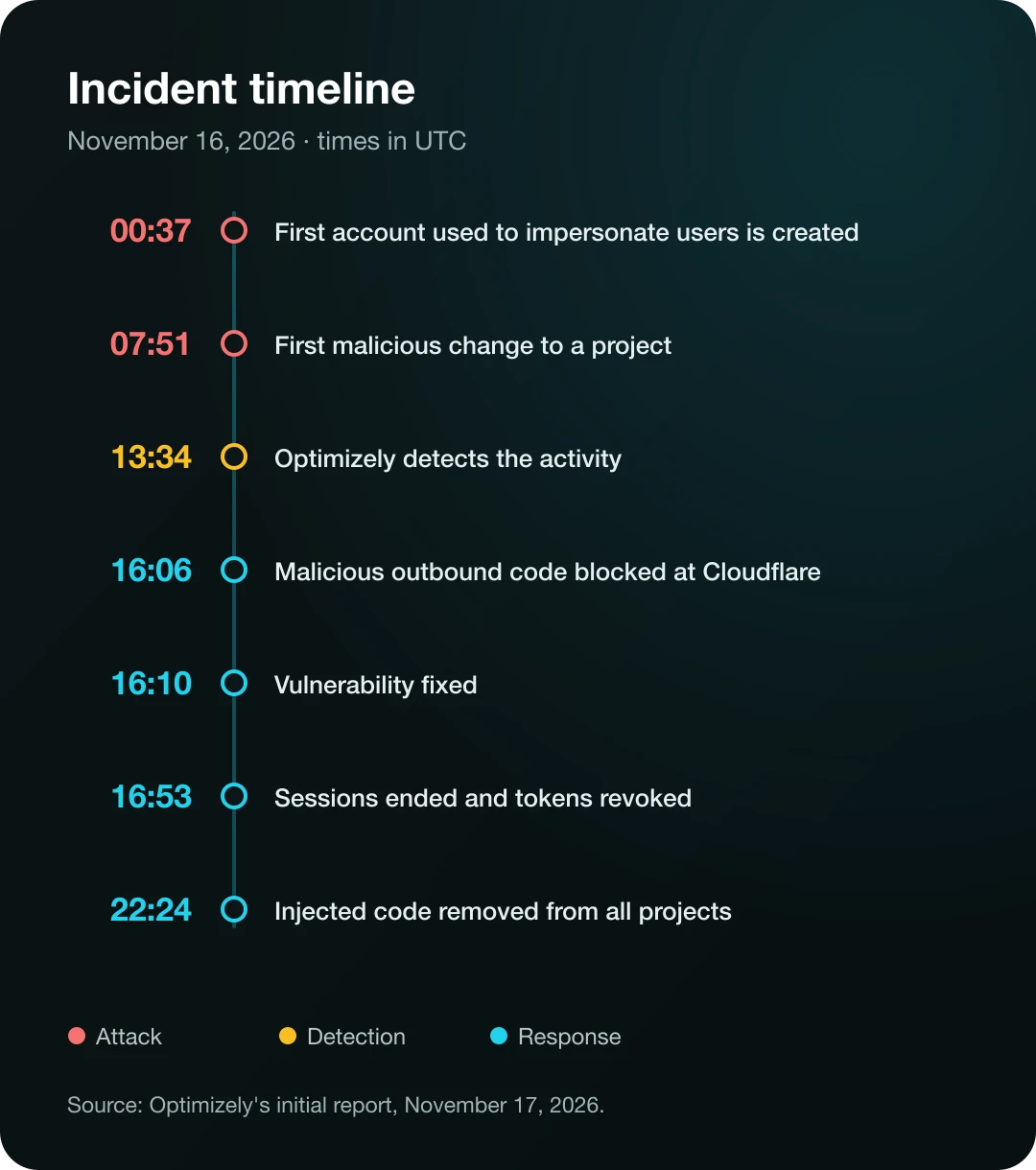
| Time (UTC) | Event |
|---|---|
| 00:37 | Creation of the first account used to impersonate users |
| 07:51 | First malicious modification of a project |
| 13:34 | Optimizely detects the suspicious activity |
| 16:06 | Outbound malicious code blocked through Cloudflare |
| 16:10 | Vulnerability fixed |
| 16:53 | Sessions terminated and tokens of impersonated users revoked |
| 22:24 | Injected code removed from all affected projects |
The company confirmed that it had blocked the vulnerability and removed the malicious code from its systems.
It also hired Mandiant to continue the independent forensic analysis.
The November 17 report was preliminary, so certain details of the investigation could still change.
Each customer's exposure window could be shorter than the total period indicated.
Source: Optimizely's official report, November 17, 2026.
Did Optimizely fix the vulnerability?
According to its official statement, yes.
Optimizely said it had fixed the flaw in the signup process, revoked the sessions used by the attackers and removed the malicious modifications.
It also implemented additional measures to prevent the code from continuing to be served.
In its November 17 report, it stated that it was safe to re-enable Web Experimentation if customers had disabled it as a precaution.
But a fixed vulnerability does not mean that all of its possible consequences have been fully investigated.
The affected organizations still needed to check which pages had loaded the scripts, what interactions may have occurred during the incident and whether there were signs of unauthorized activity.
That distinction matters.
Containing the attack stops it from continuing; investigating the incident makes it possible to determine its impact.
How can you tell whether you visited an affected page?
For an ordinary person, it is not always possible to tell.
Visiting one of the domains mentioned in the news does not automatically mean you received the malicious code.
You may not have visited a page that used the script.
It is also possible that the code had already been removed when you visited, or that certain security policies blocked it from running.
In addition, the investigation has not established that every visitor was harmed.
If you visited any of the identified sites on November 16, 2026, you can take some precautions in proportion to your activity.
If you entered card details
Review your bank transactions.
If you spot charges you don't recognize, contact your financial institution directly.
There is no need to assume that every card used on those sites was stolen.
The exposure depends on how payments were processed and on whether the malicious script ran on the relevant form.
If you made a cryptocurrency transfer
Check the destination address and the transaction history.
If you suspect you sent funds to a different address, gather the transaction details and contact the service you used.
Cryptocurrency transactions can be difficult or impossible to reverse, depending on the network and the service.
If you used an iPhone or iPad
Install the security updates available for your device.
If you notice suspicious behavior or receive a security alert, use the official support channels.
Don't install so-called cleanup tools offered through ads or messages from unknown sources.
What should companies that use Optimizely do?
Optimizely included specific recommendations in its initial report.
The first is to check whether the organization's projects were affected.
To do so, customers should review the official communication they received and contact their account manager if they need to confirm the scope.
They should then identify on which pages Web Experimentation was loaded during the exposure window.
This is especially important on pages with payment forms or cryptocurrency transfers.
They should also review security logs and network activity.
The company recommends retaining logs from servers, CDN, WAF, CSP reports and payment monitoring systems covering the day of the incident.
If signs of exposure of personal or financial information are detected, the applicable legal notification requirements should be assessed.
It should not be assumed that every company needs to change its passwords.
In fact, the official report specifies that it found no evidence of customer credential theft through this incident and that it was not necessary to reset them for this reason alone.
What is a Content Security Policy and how could it have helped?
Here is one of the most valuable lessons for people who build websites.
A Content Security Policy, or CSP, is a security policy that lets you set restrictions on the resources and code a browser can run.
For example, a site can configure rules about which JavaScript sources are allowed and to which destinations certain connections can be sent.
These measures can help reduce the impact of a code injection.
In Optimizely's case, the malicious code tried to load additional components from external infrastructure.
A sufficiently restrictive CSP could block certain of those loads.
Optimizely noted that sites with a strong CSP were protected against that mechanism of the attack.
But there is a technical detail: it is not enough to configure a list of seemingly trustworthy domains.
A poorly designed policy can still allow dangerous behavior.
In addition, certain settings such as strict-dynamic extend trust to scripts loaded by other authorized scripts, so they require special care.
The implementation must be tailored to the site and verified through testing.
You can learn more in MDN's Content Security Policy guide.
What is Subresource Integrity and what is it for?
There is another protection called Subresource Integrity, known as SRI.
Its purpose is to let the browser check, using a cryptographic hash, that an external resource matches the expected content.
If the file changes and no longer matches that value, the browser can reject it.
This is useful when we use certain external files that should remain free of unexpected changes.
However, not every resource works this way.
In tools like Optimizely, the JavaScript can change dynamically depending on the experiments or the customer's configuration.
That is why implementing SRI can be impractical without controlling or pinning versions of the content.
It is not a universal solution for every third-party integration.
The recommendation is to assess which scripts can be protected with integrity checks, which ones require dynamic execution and which additional controls are appropriate.
Source: MDN — Subresource Integrity.
The real lesson of the Optimizely incident
We often imagine that a cyberattack begins when someone manages to get into a server using a stolen password.
But the security of a modern application depends on many components.
A site may use external tools for marketing, analytics, customer support, payment processing and personalization.
Every integration introduces a dependency.
And when a service is able to run code inside a page, that dependency must be considered part of the site's security model.
The solution is not to remove every third-party service.
Many are useful and necessary.
What matters is knowing which ones we use, what permissions they have, what information they can access and how to detect abnormal behavior.
We should also avoid installing tools we don't need.
Sometimes an integration is added for a test and stays active for years, even when nobody remembers why it was installed.
Reducing unnecessary dependencies makes maintenance easier and can shrink the attack surface.
Could something similar happen on WordPress, Shopify or Webflow?
Yes, although that does not mean those platforms are affected by this incident.
The principle applies to any site that allows third-party code to be added.
In WordPress, for example, a plugin can add scripts to pages.
In Shopify, certain apps and integrations can add external resources.
In Webflow, analytics and marketing tools and custom code can also be added.
Each platform uses different mechanisms.
But the general risk lies in trusting components whose behavior can change without the site owner reviewing every update.
That is why it is a good idea to audit the integrations you use on a regular basis.
Choosing a CMS does not remove the need to apply good web security practices.
Frequently asked questions about the Optimizely hack
Was Optimizely hacked on November 16, 2026?
Yes. The company confirmed that an attacker exploited a vulnerability in Web Experimentation and modified JavaScript in certain customer projects.
How many companies were affected?
Report URI identified 188 malicious scripts associated with 178 organizations. This figure reflects the scope observed in its research and should not be read as a definitive count of organizations that suffered data loss.
Were BBC, CNN and Zoom affected?
Researchers detected tampered scripts associated with those organizations' sites. That alone does not show that their internal networks or databases were compromised.
What information were they trying to steal?
The code was designed to try to capture card data entered into certain forms, alter cryptocurrency addresses and carry out other malicious activity in the browser.
Were iPhone users at risk?
The research detected exploitation components targeting certain vulnerable versions of iOS and iPadOS. That does not mean every exposed device was compromised. Keeping the system up to date reduces the risk from vulnerabilities that have been fixed.
Were Optimizely customers' passwords stolen?
Optimizely stated that this was not a credentials leak and that it found no evidence that customer passwords were exposed as a result of this incident.
Has the attack been resolved?
Optimizely reported that it had fixed the vulnerability and removed the malicious code on November 16. The forensic investigation was still ongoing according to its report the following day.
What is a supply chain attack?
It is an attack that compromises a component, provider or dependency used by other organizations, allowing the impact to reach systems that were not attacked directly.
How can I protect my website?
Keep an inventory of third-party scripts, remove unnecessary integrations, apply least-privilege permissions and consider controls such as CSP, SRI, change monitoring and security alerts.
Conclusion: you don't need to hack a company to put its visitors at risk
The Optimizely attack shows just how much websites depend on third-party services.
A vulnerability in a shared component made it possible to modify code that could run on the pages of international organizations.
And that turned one specific flaw into an incident of much wider reach.
The company confirmed that it fixed the problem, but the investigation also left an important lesson for developers and site owners.
Protecting administrators' passwords is not enough.
We also need to understand what code we run, who can modify it and what happens when one of our providers suffers a security incident.
Because a website can be legitimate, use HTTPS and belong to a well-known company, and still depend on a vulnerable external component.
Security is not only about protecting our own code.
It is also about properly managing the trust we place in other people's software.
About the author
Rafael Azuaje is a computer engineer with experience in web development and UX/UI design. He shares content about artificial intelligence, software development, automation and digital security, explaining technology concepts in an accessible way and with verifiable sources.
Article updated on November 18, 2026. The forensic investigation of the incident was still ongoing according to Optimizely's initial report.