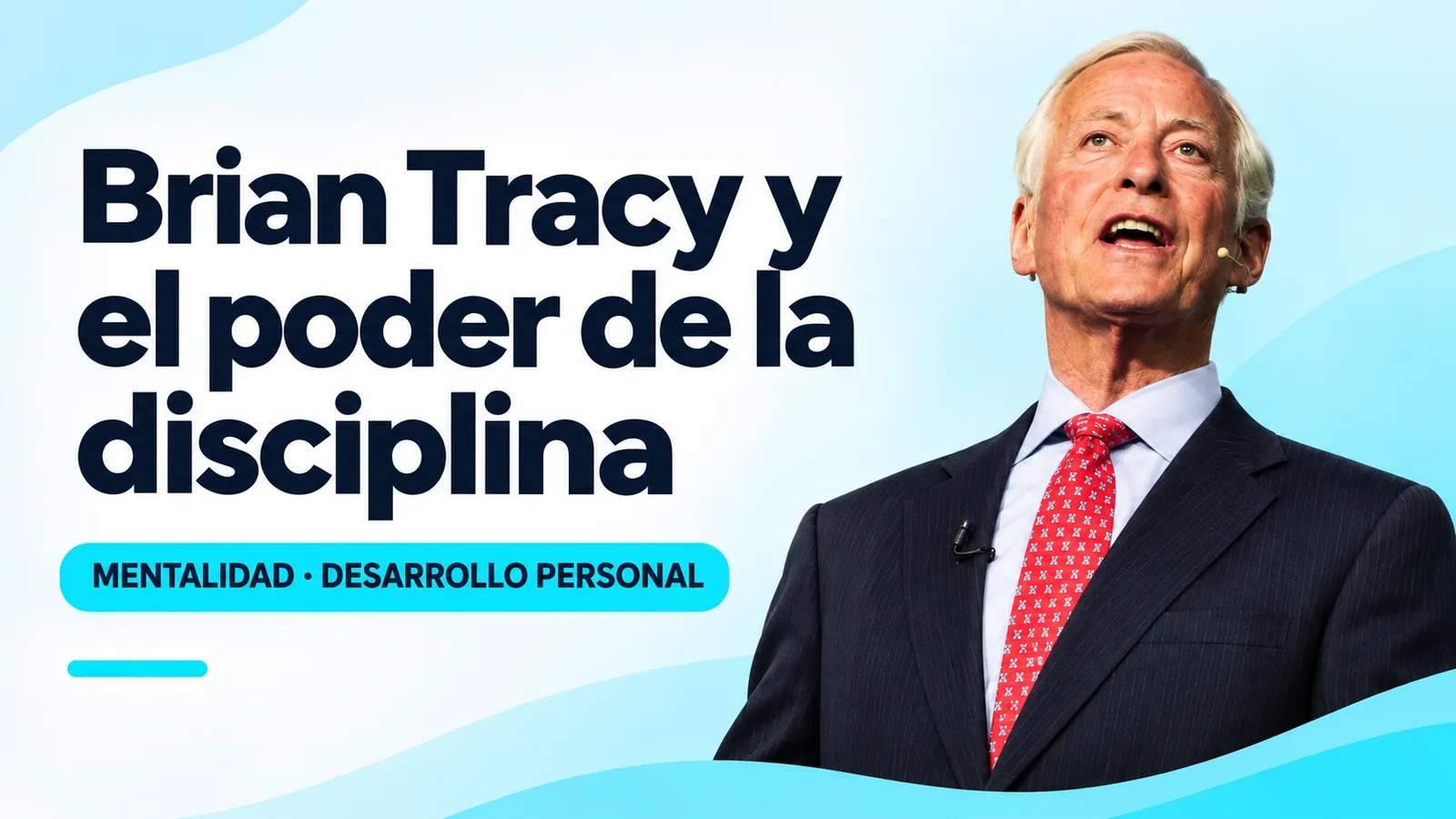
Some people become known for building companies, inventing technologies or transforming industries.
Others have an influence that shows up in a less visible way: in the habits, decisions and ways of thinking of the people who listened to what they taught.
Brian Tracy belonged to the second group.
For decades, his books, talks and training programs helped popularize ideas about productivity, discipline, leadership and goal setting.
You have probably heard some of his advice, even if you never read one of his books.
For example, starting the day with the most important task instead of leaving it for later.
Or writing down your goals to turn them into concrete actions.
On November 12, 2026, the Canadian-American author and speaker died at the age of 82.
His passing marks the end of a long career devoted to personal development.
But it also invites us to revisit a question that is still relevant: which of his teachings remain useful in a world where technology is changing the way we work?
Brian Tracy died on November 12, 2026
Brian Tracy was born on January 5, 1944, in Charlottetown, in the Canadian province of Prince Edward Island.
He died on Thursday, November 12, 2026, at the age of 82, according to reports published by international media and tributes from people close to him.
One of the most personal farewell messages was shared by his grandson Will Stein.
In his tribute, Stein recalled the trust his grandfather had placed in him and the influence he had on the way he understood entrepreneurship and success.
He also said that he had spoken with Tracy the night before his death.
The farewell revealed a less familiar side of the speaker: that of a grandfather who passed on to his family the same principles he had shared with his followers for decades.
Another tribute, published by Lanny, a friend of Tracy's, recalled parts of a conversation the two had in September 2026.
According to that account, Tracy was still talking about his experiences, lessons and philosophy of life just a few months before his passing.
Martial Arts Professional magazine also remembered him in an independently published tribute, which highlights his side as a black belt and instructor.
As of the publication date of this article, no confirmed cause of death has been publicly disclosed.
Out of respect for his family, it is not our place to speculate about it.
Sources: Tribute to Brian Tracy, 1944–2026 and La Prensa — Death of Brian Tracy.
Who was Brian Tracy?
Brian Tracy was an author, entrepreneur, consultant and speaker specializing in personal and professional development.
Over the course of his career, he worked in areas such as sales, marketing, management and business consulting.
He later turned his experience and research into books, educational programs and seminars.
He founded Brian Tracy International, an organization dedicated to training professionals, entrepreneurs and companies.
His approach centered on a recurring idea: improving personal and professional results through clear goals, consistent habits and deliberate action.
According to the biography published by his own company, Brian Tracy gave approximately 5,000 talks and seminars, reaching a cumulative audience of more than five million people.
He also published more than 70 books, translated into many languages.
These are figures presented by his organization, not the results of an independent audit.
His influence extended to topics such as leadership, sales, productivity and time management.
Source: Brian Tracy International — Official biography.
From his early jobs to becoming an international speaker
Tracy's career did not begin directly in publishing.
Before devoting himself to professional training, he worked in a range of sales and business activities.
His biography mentions experience in sales, marketing, investments, real estate development and consulting.
These activities shaped the practical approach that would later characterize his talks.
Instead of focusing only on abstract ideas about motivation, Tracy presented procedures for setting goals, organizing priorities and improving results.
His work was also influenced by his study of subjects such as business, history, philosophy and psychology.
That does not mean all of his proposals are equivalent to proven scientific findings.
His programs should be understood mainly within the field of business training and personal development.
Even so, some of his recommendations are still useful as tools for organization and reflection.
The Phoenix Seminar: one of his best-known projects
An important part of his career is tied to the Phoenix Seminar, known in full as The Phoenix Seminar on the Psychology of Achievement.
According to accounts of his career, Brian Tracy began teaching this program in the early 1980s; several accounts place it in 1981.
Its goal was to bring together ideas related to goal setting, personal attitude, habits and performance.
The seminar evolved over time and gave rise to various training materials and programs.
A documented edition of its content appears in a 1988 publication titled The Phoenix Seminar on the Psychology of Achievement.
The program also served as a forerunner to other training offerings, such as The Power of Personal Achievement, where Tracy himself recalls the Phoenix Seminar as his best-selling program.
In these materials, Tracy laid out his view of how decisions, habits and goals could shape a person's development.
For his followers, the Phoenix Seminar was a structured introduction to his principles of success and productivity.
It is important to distinguish these teachings from a guarantee of results.
No seminar can promise that everyone will reach the same goals, because opportunities also depend on economic, social and personal circumstances.
But the program helped spread organizational tools that many people built into their routines.
Sources: Google Books — The Phoenix Seminar and Brian Tracy — The Power of Personal Achievement.
Brian Tracy's best-known books
Although Tracy developed many educational programs, his books were one of the main ways his work reached readers in different countries.
Among his best-known works are the following.
Eat That Frog!
It is probably his best-known book on productivity.
Its central idea is that we should identify our most important tasks and avoid putting them off.
The title uses the metaphor of eating a frog to represent a difficult or unpleasant task we would rather avoid.
In practical terms, the advice is to start with a high-impact activity instead of filling the whole day with secondary matters.
It does not mean we should always do the hardest task first.
Difficulty and importance are not necessarily the same thing.
What really helps is identifying which activity has the most value for our goals.
Goals!
This book explores the importance of setting clear goals and turning them into action plans.
Tracy argued that formulating concrete goals helps guide everyday decisions.
But writing down a goal does not guarantee achieving it.
We also need to assess resources, obstacles, deadlines and circumstances.
No Excuses!
It focuses on personal discipline and the ability to maintain consistent behavior.
The main idea is that many important activities require us to act even when we do not feel immediately motivated.
However, it is important not to confuse self-discipline with working nonstop without rest.
A sustainable routine also needs recovery and healthy limits.
The Psychology of Achievement
It is one of the educational programs most closely associated with the early years of his work as a speaker.
It explores ideas related to goals, self-concept and personal performance.
These works share one principle: progress usually requires turning general intentions into concrete behavior.
Source: Brian Tracy — Personal development programs and books.
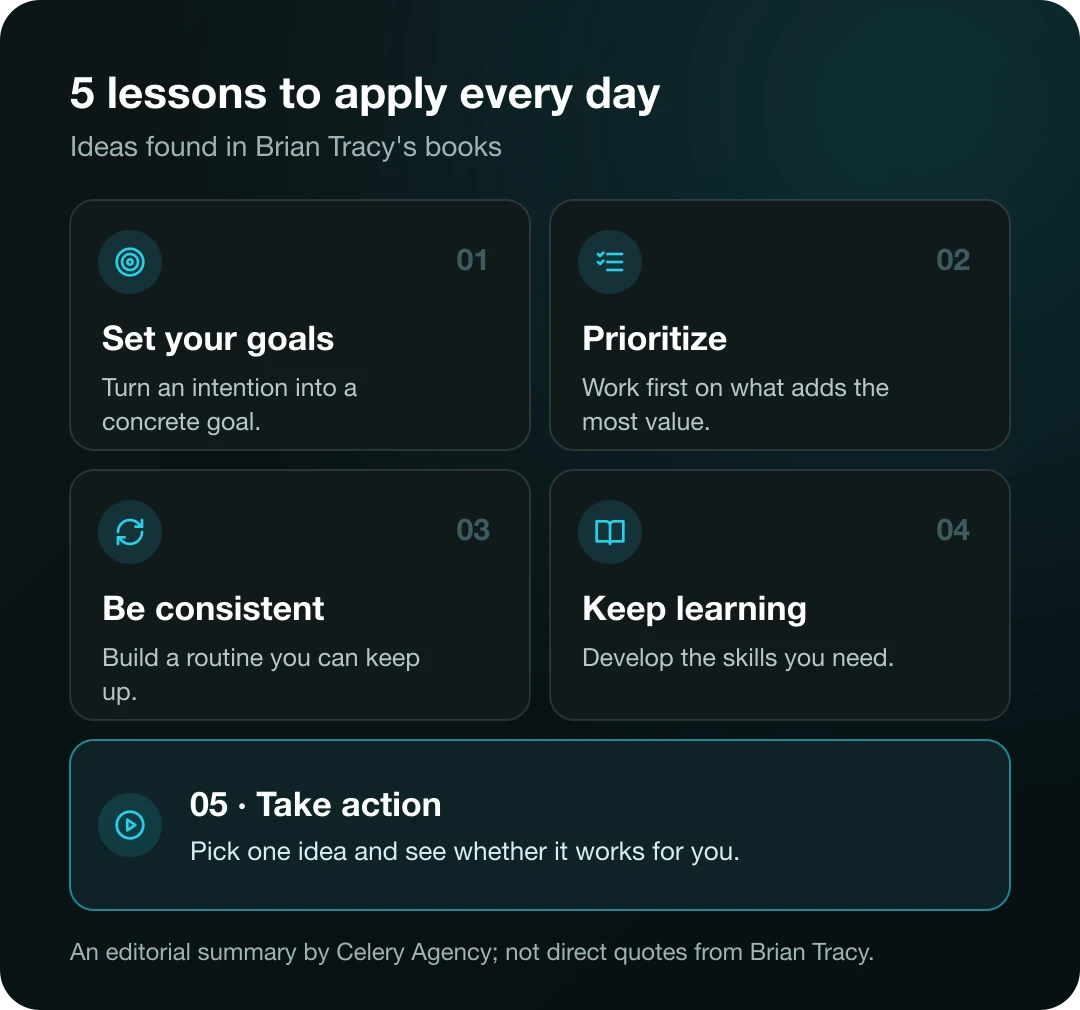
Five Brian Tracy lessons that are still useful
We can take several ideas from his books without having to accept all of his claims as universal truths.
1. Start with what matters, not with what is easiest
One of the most common productivity traps is confusing being busy with making progress.
You can answer twenty emails, organize your folders and attend several meetings without having done the most important work of the day.
The approach in Eat That Frog! invites you to identify your priorities first.
For example, if you are building a website for a client and need to deliver an essential feature, it is probably more important to get that done than to spend an hour tweaking secondary visual details.
A simple way to apply this idea is to choose one priority task before your workday begins.
2. Turn general goals into concrete actions
Saying "I want to learn to code" can be a valid intention.
But it still does not explain what you will do tomorrow.
A more useful goal might be:
"Over the next four weeks, I will study JavaScript fundamentals and build a small application."
The aim is to turn a broad aspiration into activities that can be carried out and evaluated.
You also need to adapt the plan when circumstances change.
3. Consistency matters more than initial enthusiasm
It is easy to feel motivated when starting a project.
The hard part usually comes later, when results are slow to arrive.
Tracy devoted a significant part of his work to explaining the role of habits.
In practical terms, building a routine can help you rely less on improvised decisions.
For example, studying thirty minutes a day may be more sustainable for some people than trying to learn for eight hours once a month.
But routines must be adapted to individual needs.
There is no number of hours that works for everyone.
4. Continuous learning expands your options
This lesson is especially relevant in 2026.
Artificial intelligence, automation and new digital tools are changing many work processes.
Continuous learning no longer means piling up courses.
It means identifying the knowledge you need and putting it into practice.
For example, a designer can learn to use AI tools without abandoning the fundamentals of design.
An administrative professional can adopt automations to reduce repetitive tasks.
And a developer can learn new systems while keeping a solid grounding in programming.
5. Knowledge needs to become action
Reading about productivity is not the same as getting better organized.
You can finish ten books on time management and keep working the same way.
That is why it makes sense to pick one specific idea and put it to the test.
For example, if you are ending your days with too many unfinished tasks, you can try planning three priorities for the next day.
After a week, evaluate whether it actually helped you.
Reflection and follow-up let you know whether a technique works in your context.
What can professionals who use artificial intelligence learn from Brian Tracy?
Although Tracy developed much of his teaching before generative AI became popular, some of his ideas can be applied to today's work.
Today we have tools that can write, code, design and summarize information in seconds.
But using more technology does not necessarily mean being more productive.
Imagine spending the whole morning trying out new artificial intelligence tools.
You generate images, compare answers and experiment with different assistants.
It may be interesting.
But if by the end of the day you have not made progress on the project you needed to deliver, you may have confused activity with progress.
This is where a connection with Tracy's ideas appears.
Before choosing a tool, it helps to define what problem we want to solve.
Artificial intelligence can help carry out certain tasks, but it does not automatically decide which ones matter for our lives or our work.
We also need to learn to recognize when an answer is wrong.
And that responsibility does not go away just because a system produces results quickly.
Technology can multiply our capacity to produce.
Judgment is still needed to decide what to use it for.
Brian Tracy's influence on entrepreneurs and professionals
Tracy's teachings found a sizable audience among salespeople, business owners, executives and professionals interested in improving their results.
His approach was accessible: turning broad ideas about success into concrete recommendations.
For example, writing down goals, organizing priorities, practicing sales skills and setting aside time for learning.
This helped his content circulate through books, recordings and talks.
But we should also recognize the limits of personal development.
Not every difficulty can be solved through individual discipline.
Working conditions, access to education, economic circumstances and other factors affect the real opportunities people have.
That is why it is more useful to treat his recommendations as tools that can be adapted, not as universal rules that guarantee success.
His legacy can be valued without turning each of his ideas into a scientific claim.
Was Brian Tracy the creator of the Phoenix Seminar?
Yes.
Tracy developed and taught the program known as The Phoenix Seminar on the Psychology of Achievement.
Accounts of his career place the start of this program in the early 1980s; several place it in 1981.
Later published materials document the seminar and its content.
Over time, the program's ideas also appeared in other training initiatives.
That is why it is accurate to recognize him as the creator of the Phoenix Seminar, although that title should not be confused with all the personal development programs he taught later.
What was Brian Tracy's cause of death?
As of November 18, 2026, I have not found a reliably reported, publicly disclosed cause of death.
Reports agree that he died on November 12 at the age of 82, and outlets such as El Tiempo expressly state that the cause has not been disclosed.
His family and people close to him shared farewell messages, but that does not mean they have released any medical details.
Therefore, any claim about a specific illness or unconfirmed medical circumstance would be speculative.
Frequently asked questions about Brian Tracy
When did Brian Tracy die?
He died on November 12, 2026, at the age of 82, according to news reports and tributes published by family members and people close to him.
Where was Brian Tracy born?
He was born on January 5, 1944, in Charlottetown, Prince Edward Island, Canada.
What made Brian Tracy famous?
He became known for his books, seminars and training programs on productivity, sales, leadership, goal setting and personal development.
What is his most famous book?
One of his best-known books is Eat That Frog!, published in Spanish as ¡Tráguese ese sapo!, which focuses on time management and priorities.
What was the Phoenix Seminar?
It was a program developed by Brian Tracy on the psychology of achievement, habits, goal setting and personal growth. He began teaching it in the early 1980s.
How many books did Brian Tracy write?
The Brian Tracy International biography credits him with more than 70 books translated into many languages. Some more recent sources mention higher numbers, depending on which titles and editions are counted.
How many people attended his talks?
According to his organization, he reached a cumulative audience of more than five million people across approximately 5,000 talks and seminars.
What did Brian Tracy die of?
The cause of his death has not been publicly disclosed in a confirmed way.
Which of Brian Tracy's lessons is still especially useful?
One of the most practical is to prioritize important tasks and turn goals into concrete actions. How useful it is depends on how each person adapts these ideas to their own circumstances.
Conclusion: Brian Tracy's legacy goes beyond his books
Brian Tracy devoted much of his life to teaching that our everyday decisions can shape the results we achieve.
His books and talks helped popularize tools for setting goals, managing time and building habits.
Not all of his ideas have to be accepted without question.
Some need to be adapted, and others should be understood within the context of personal development.
But his work leaves a reflection that is still useful.
Today we have more technological tools than ever to learn, create and work.
We can use artificial intelligence to automate tasks and access information with an ease that seemed impossible just a few years ago.
Even so, we still need to decide what we want to achieve and how we are going to use our time.
Perhaps one of the best ways to remember Brian Tracy is to apply one of his simplest recommendations.
Choose something important.
Turn it into a concrete goal.
And start working on it.
Because no tool, book or talk can make for us all the decisions that shape our lives.
About the author
Rafael Azuaje is a computer engineer with experience in web development and UX/UI design. He publishes educational content about technology, artificial intelligence and automation, with a practical approach to help people learn, develop sound judgment and make better use of digital tools.
Article updated on November 18, 2026. The biographical details were checked against the Brian Tracy International biography, news reports and tributes published after his death.