

For more than three decades, Jensen Huang was much more than NVIDIA's chief executive.
He was one of its founders, the public face of its presentations, and one of the figures who helped turn a graphics card company into one of the most important companies in the artificial intelligence industry.
That is why, when NVIDIA confirmed his resignation on November 12, 2026, the news had repercussions that reached far beyond Silicon Valley.
Huang left his positions as President and CEO, as well as his seat on the board of directors.
The company named Colette Kress interim CEO and began the search for a permanent replacement.
But the most important question is not just who will take his place.
What happens when such an influential company loses the leader who has run it since its founding?
To understand that, we need to look at what has been confirmed, what is known about the circumstances of his departure, and the challenges NVIDIA now faces.
Jensen Huang officially resigned from NVIDIA on November 11, 2026
Jensen Huang's departure was confirmed in an official NVIDIA press release published on November 12.
In the release, the company reported that Huang had stepped down as President, CEO and member of the board of directors, effective immediately.
The decision was also filed with the US Securities and Exchange Commission in a Form 8-K.
That filing states that the board accepted the resignation on November 11, 2026.
It is important to distinguish between the two dates: the change took effect on November 11, and NVIDIA announced it publicly on the 12th.
The company also confirmed two appointments.
Colette Kress, until then NVIDIA's chief financial officer, took over as interim chief executive.
Harvey C. Jones was named Chair of the Board.
In doing so, NVIDIA separated the responsibilities of the board from those of executive management, roles Huang had held together for much of his career.
Official source: NVIDIA — Announces CEO Transition, November 12, 2026.
Why did Jensen Huang resign?
This is the question that has drawn the most interest.
The resignation came after reports about his personal conduct and concerns related to a possible foreign intelligence operation.
On November 8, 2026, NVIDIA's board had announced an independent investigation following reports indicating that Huang may have been the target of a foreign intelligence effort.
At the time, the board said it had no reason to believe that NVIDIA's confidential information or US national security had been compromised.
The investigation was to examine the available information.
Reuters later reported on Huang's personal relationships and on internal communications that, according to its sources, raised questions about what certain executives knew about those relationships.
These reports are part of the context of the crisis, but it is important to distinguish journalistic reporting from facts that have been officially established.
It would not be appropriate to present any involvement in espionage or illegal technology transfer as proven without conclusive evidence.
In remarks reported during the November 17 earnings presentation, Chair of the Board Harvey Jones linked the resignation to the disclosure of personal conduct that the company considered incompatible with its standards and code of conduct.
The board also confirmed that it had no intention of reinstating Huang as CEO.
There are therefore two distinct elements: the confirmed resignation, and the investigations and reports about its circumstances.
The first is an official fact. Details about any additional responsibility should be treated with caution while the relevant investigations remain open.
Sources: NVIDIA — Board of Directors statement, November 8, 2026 and Reuters — Investigative report, November 13, 2026.
Who is Jensen Huang, and why does his departure matter so much?
To understand the impact of the news, we have to go back to 1993.
That year, Jensen Huang founded NVIDIA together with Chris Malachowsky and Curtis Priem.
The company started out developing graphics technologies and later became a global benchmark in accelerated computing.
One of its milestones was the launch of the GeForce 256 GPU in 1999.
Over the years, its graphics processors began to be used for much more than video games.
Their ability to perform calculations in parallel opened up opportunities in scientific simulation, data processing and machine learning.
NVIDIA also developed CUDA, its parallel computing platform, which became an important part of the accelerated development ecosystem.
When modern artificial intelligence began to demand enormous amounts of computing power, NVIDIA already had an established position in both hardware and software.
The growth of language models and AI data centers strengthened its importance even further.
But NVIDIA's story cannot be attributed to a single person alone.
Its results also depend on thousands of engineers, researchers, manufacturers, technology partners and outside developers.
Even so, Huang represented something uncommon: a founder who remained at the helm of the company for roughly 33 years.
His departure raises the challenge of sustaining a complex technology strategy without the figure who had led the organization from the start.
Source: NVIDIA — Official biography of Jensen Huang.
Who is Colette Kress, NVIDIA's new interim CEO?
The person who has temporarily taken charge of NVIDIA is Colette Kress.

Kress joined the company in September 2013 and has held financial leadership roles since then.
Before joining NVIDIA, she built her career at technology companies such as Cisco and Microsoft, according to her official biography.
Her experience includes financial planning, investor relations and the management of corporate operations.
In its November 12 press release, NVIDIA explained that Kress would keep her responsibilities as chief financial officer while serving as interim CEO.
That means this is not, for now, the permanent appointment of a successor.
The company has started a process to identify the person who will take over the leadership permanently.
And the fact that Kress has held a top-level position for years provides important continuity for financial and operational management.
But it remains to be seen how NVIDIA's strategic direction evolves during this period.
NVIDIA also named Harvey Jones Chair of the Board
Another significant change was the appointment of Harvey C. Jones.
Jones had been a member of NVIDIA's board of directors since 1993.
He also has a background tied to technology companies, investments and organizations in the semiconductor industry.
With his appointment, the board now has a chair who is a different person from the one running day-to-day operations.
This distinction matters because the board of directors and the CEO play different roles.
The board oversees strategy and certain corporate governance responsibilities.
The CEO is responsible for leading the operational execution of that strategy.
In such a significant transition, coordination between the two will be essential.
NVIDIA rules out Jensen Huang's return as CEO
The story took a new turn on November 17, 2026.
After his resignation, Huang said publicly that he would be willing to lead NVIDIA again if the board believed his return would benefit the company.
However, during the presentation of financial results for the third quarter of fiscal 2027, Harvey Jones ruled out that possibility.
According to reports from Reuters and TechCrunch, the board had unanimously accepted the resignation and had no plans to reinstate him.
The company also turned to an executive search firm to help find a permanent successor.
This means that, as of our editorial cutoff on November 18, 2026, the situation is clear:
Jensen Huang is no longer NVIDIA's CEO.
Colette Kress holds the position on an interim basis.
And the board is still searching for a permanent replacement.
Although the process could lead to new announcements, it is not yet possible to say who the next permanent CEO will be.
Sources: Reuters — NVIDIA rules out rehiring Huang, November 17, 2026 and TechCrunch — The board does not plan to reappoint him.
What does Huang's departure mean for NVIDIA's future?
A leadership transition always creates uncertainty.
But when it happens at a company that holds a fundamental position in artificial intelligence infrastructure, the questions take on a different dimension.
NVIDIA does not just make graphics cards.
Its business includes data center systems, high-performance networking, AI accelerators, software and development platforms.
Many companies depend on these technologies to train and run artificial intelligence models.
That is why the market needs to know whether NVIDIA will maintain its technology development plans, commercial agreements and investment strategy.
The board said it expects to continue its operations and commitments without interruption.
However, that statement is an expectation on the company's part, not a guarantee that the transition is free of risk.
Among the most important challenges are maintaining the trust of customers, investors and employees, retaining key talent, and executing a demanding technology roadmap.
There is also a leadership challenge.
Huang had played a very visible role in product launches and in relationships with strategic partners.
His successor will have to develop their own way of communicating and executing the strategy.
NVIDIA reports record results despite the leadership change
One figure helps explain the economic context of this transition.
On November 17, 2026, NVIDIA reported its results for the third quarter of fiscal 2027, covering the period ended October 25.
The company reported revenue of $115.8 billion, up 103% from the same quarter a year earlier.
The data center division posted revenue of $107.6 billion, a 110% year-over-year increase.
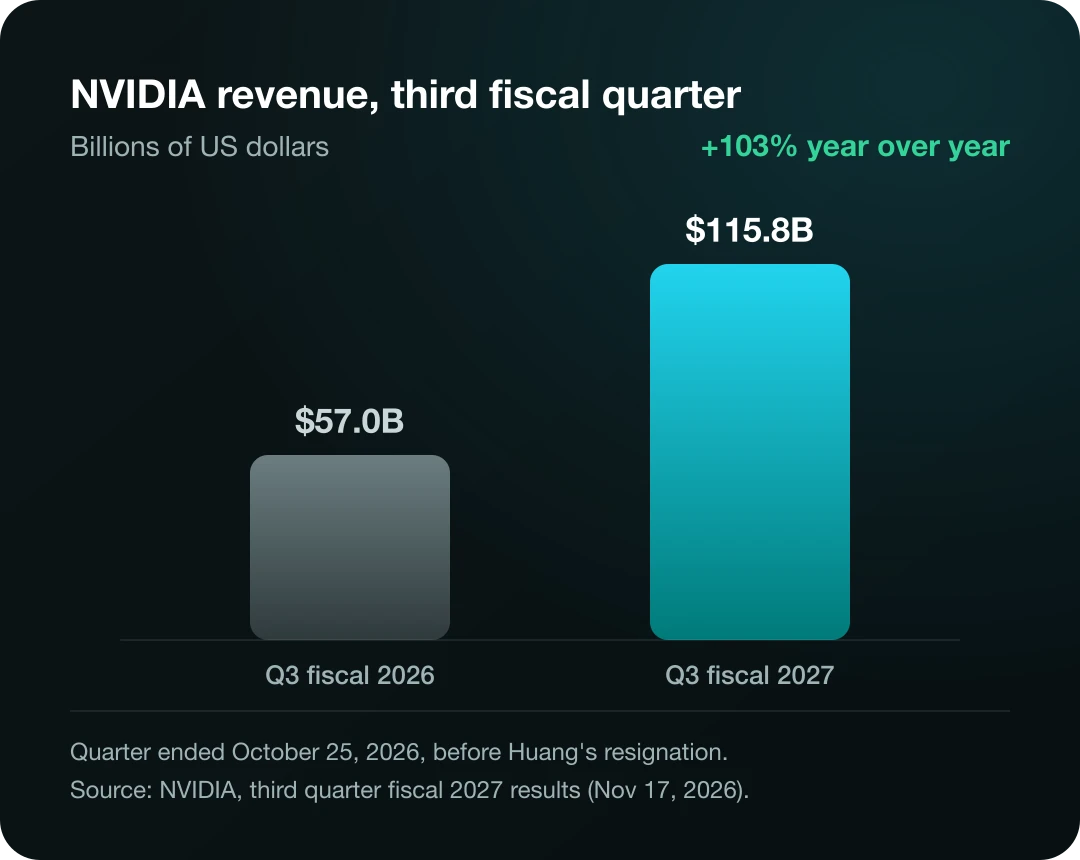
These results cover a quarter that closed before Huang's resignation.
They should therefore not be interpreted as evidence that his departure either helped or hurt the business.
But they do show that the transition is happening at a time when demand for NVIDIA's technologies is extraordinarily high.
The company also issued a revenue outlook of approximately $130.0 billion, plus or minus 3%, for the next fiscal quarter.
An outlook, of course, is not the same as a result already achieved.
Investors will have to watch whether the company keeps up its pace of growth while it reorganizes its leadership.
Source: NVIDIA — Financial results for the third quarter of fiscal 2027.
Will artificial intelligence depend less on NVIDIA without Jensen Huang?
A change in leadership is unlikely to immediately change the industry's technical needs.
Companies that use NVIDIA infrastructure still need processing capacity, networking, storage systems and software tools.
Nor do developers automatically abandon a platform because its manufacturer changes CEOs.
However, leadership can influence research priorities, business relationships and investment decisions.
In such a competitive market, those factors matter.
It is also worth remembering that NVIDIA faces competition from other chipmakers and from companies developing their own accelerators.
That is why its future will depend as much on the quality of its products as on its ability to sustain an ecosystem of software and partners.
Reducing NVIDIA's entire future to a single person would be an oversimplification.
But ignoring Huang's historical importance would also make it impossible to grasp the scale of this transition.
A timeline of NVIDIA's crisis in November 2026
| Date | Event |
|---|---|
| November 8 | NVIDIA announces an independent investigation related to reports of a possible foreign intelligence effort targeting Huang. |
| November 11 | The board accepts Jensen Huang's resignation. |
| November 12 | NVIDIA publicly announces the transition and the appointment of Colette Kress as interim CEO. |
| November 13 | Reuters publishes additional information about the personal circumstances of the crisis. |
| November 17 | NVIDIA reports financial results, and the board rules out reinstating Huang as CEO. |
| November 18 | The search for a permanent successor continues, according to publicly available information. |
This timeline distinguishes the company's announcements from news reports.
What can businesses learn from what happened at NVIDIA?
Beyond the controversy, the case raises a question of corporate governance.
How prepared is an organization to function without its founder?
Many companies build their identity around one person.
That can be an advantage during growth stages, especially when the founder has a recognized vision.
But it can also become a vulnerability if there are no structures capable of sustaining the company through an unexpected transition.
In NVIDIA's case, the interim leadership, the separation of responsibilities and the search for a successor show mechanisms for managing the change.
It is still too early to conclude whether they will be enough.
The lesson for other businesses is that a strong organization needs processes, teams and oversight mechanisms that do not depend entirely on a single person.
Frequently asked questions about Jensen Huang's resignation
Did Jensen Huang really resign from NVIDIA?
Yes. NVIDIA publicly confirmed his resignation on November 12, 2026, and filed the change with the SEC. The departure took effect on November 11.
Why did Jensen Huang leave NVIDIA?
His departure came amid reports about his personal conduct and an investigation related to possible foreign intelligence risks. The board later linked the resignation to conduct incompatible with the company's standards. Not all details of the investigations have been publicly established.
Who is NVIDIA's new CEO?
Colette Kress is the interim chief executive. NVIDIA has yet to name someone to fill the position permanently.
Can Jensen Huang return to NVIDIA?
Huang expressed willingness to return, but NVIDIA's board ruled out reinstating him as CEO on November 17, 2026. There has been no confirmed announcement of his return.
How many years did Jensen Huang lead NVIDIA?
Roughly 33 years. He founded the company in 1993 and led it until November 2026.
Did the resignation affect NVIDIA's results?
The results released on November 17 cover a quarter that ended before the resignation. They cannot be used to measure its subsequent financial effects.
Who is Harvey Jones?
He is the Chair of NVIDIA's Board of Directors, appointed during the November 2026 transition. He had served on the board since 1993, the year the company was founded.
What will happen to NVIDIA's chips and AI platforms?
The company said it will continue executing its roadmap and meeting its commercial commitments. How those plans evolve will have to be confirmed by future announcements and results.
Conclusion: NVIDIA faces the biggest leadership change in its history
Jensen Huang's resignation marks the end of an exceptional era.
For 33 years, he helped lead NVIDIA's transformation from a graphics company into one of the leading artificial intelligence infrastructure companies.
His departure is a confirmed fact.
But the consequences of this transition have yet to unfold.
NVIDIA retains a strong technology position, an evolving product portfolio and financial results that show strong growth.
At the same time, it needs to find a new leader, respond to corporate governance concerns and maintain the trust of its customers and partners.
The real test will be whether NVIDIA can sustain its strategy without the person who led it from its founding.
And that answer will not come from a single earnings report.
It will become clear through the decisions the company makes over the coming months.
About the author
Rafael Azuaje is a computer engineer with experience in web development and UX/UI design. He publishes educational content about technology, artificial intelligence, automation and software development, aiming to explain technology news with verifiable sources and accessible context.
Information current as of November 18, 2026. This article distinguishes between confirmed corporate facts, official statements, news reports and business projections.