Can you imagine downloading thousands of movies in just one second?
While many people are still signing up for internet plans of 300, 600 or 1,000 megabits per second, Japanese researchers managed to transmit data at a speed so high that home connections look tiny by comparison.
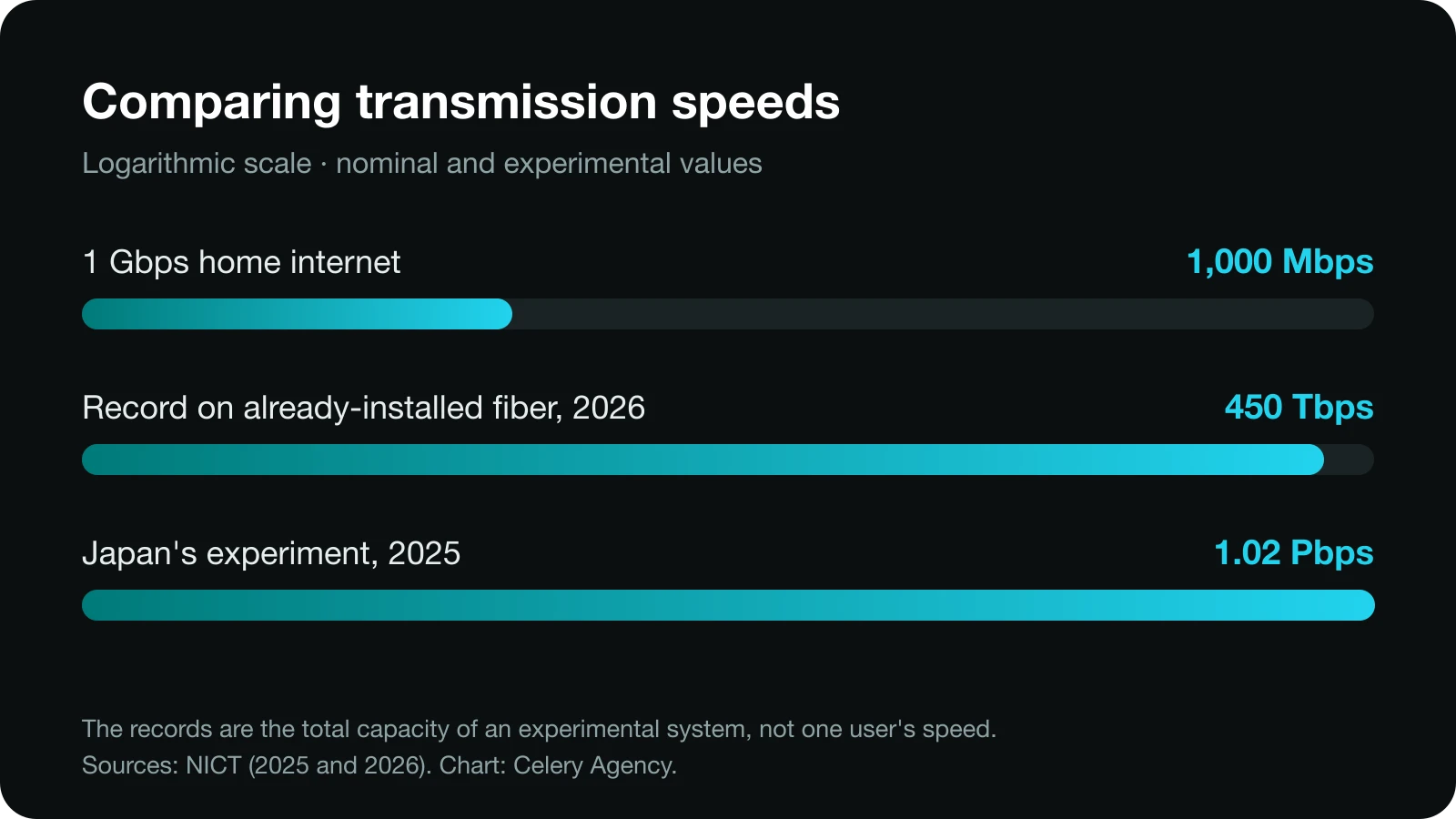
We are talking about 1.02 petabits per second.
To put that in perspective, it equals 1.02 billion megabits per second. That is a transmission capacity more than a million times greater than the advertised speed of a 1 Gbps home connection.
And the most interesting part is not just the number. The researchers managed to send that huge amount of data across 1,808 kilometers of optical fiber.
However, there is a detail that many headlines overlook: this does not mean you can sign up for that kind of speed at home.
So what exactly did they achieve? How did they do it? And which countries really have the fastest internet in 2026?
Let's take it step by step.
Japan and the 1.02 petabits per second record
On May 29, 2025, Japan's National Institute of Information and Communications Technology (NICT), together with Sumitomo Electric and other partners, announced an optical transmission demonstration that reached 1.02 petabits per second over 1,808 kilometers.
The result was achieved using an experimental 19-core optical fiber.
To understand why this matters, you first need to know how the optical fiber we use today works.
Fiber carries information using light signals. In conventional connections, those signals travel through a core that acts as the transmission channel.
The researchers used a fiber that contains 19 cores inside a structure with an outer diameter similar to that of a conventional fiber: about 0.125 millimeters.
In other words, they managed to multiply the paths available to carry information without significantly increasing the diameter of the cable.
The goal was not to bring ultra-fast internet into a home, but to demonstrate a technology capable of carrying enormous amounts of data over long distances.
Source: NICT — 1.02 Pb/s record over 1,808 km.
How fast is a petabit per second, really?
When we talk about home connections, we usually use megabits per second (Mbps) or gigabits per second (Gbps).
But when we reach speeds as high as those in the Japanese experiment, we need a different unit: the petabit.
Here is how they relate:
| Unit | Equivalent |
|---|---|
| 1 megabit (Mb) | 1 million bits |
| 1 gigabit (Gb) | 1,000 megabits |
| 1 terabit (Tb) | 1,000 gigabits |
| 1 petabit (Pb) | 1,000 terabits |
So 1.02 petabits per second means 1,020 terabits per second, or 1,020,000 gigabits per second.
That is an amount of information that is hard to imagine.
An example to make sense of it
Let's say you want to download a 100 GB file.
On an ideal 1 Gbps connection, the transfer would take about 13 minutes and 20 seconds.
If a single transfer could fully use a capacity of 1.02 Pb/s, sending that same data would take less than a thousandth of a second.
Of course, this second scenario is a mathematical comparison, not a real home download.
In practice, other factors come into play, such as the limits of servers, devices, network protocols and the available infrastructure.
Also, the NICT record measures the total combined capacity of a transmission system, not the download speed of a single computer.
That difference is crucial.
How did they manage to send so much information?
The experiment combined several advanced technologies.
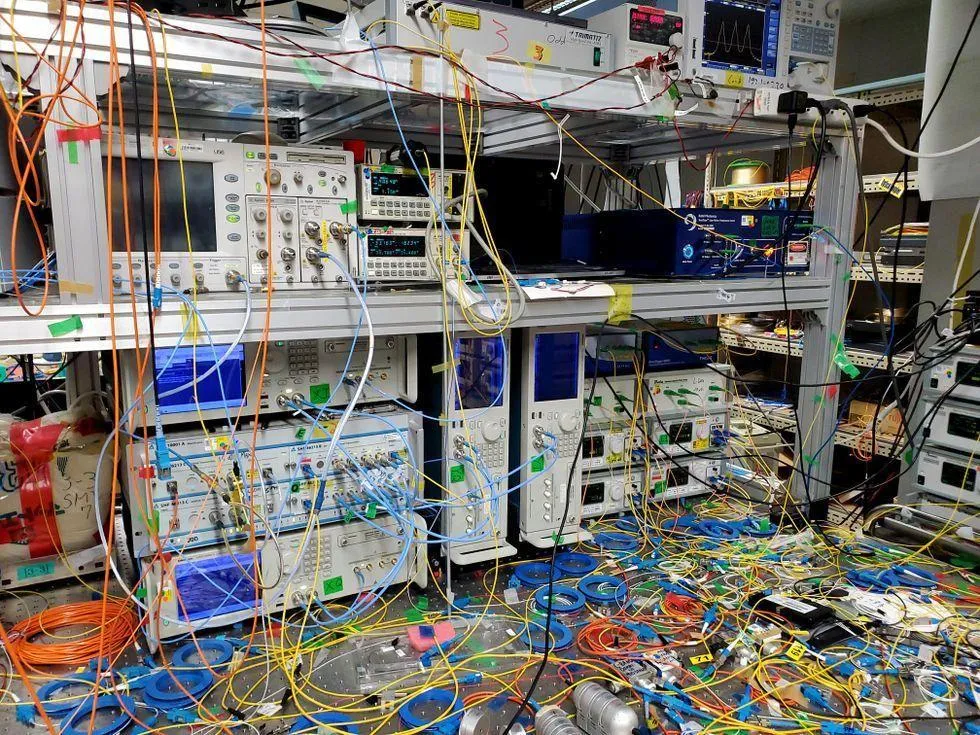
The first was the use of a 19-core optical fiber. Instead of relying on a single path to carry data, the system made it possible to send multiple signals in parallel.
The second was taking advantage of several wavelength bands of light.
This matters because an optical fiber can carry different signals at the same time using different wavelengths, through a technique known as wavelength-division multiplexing.
Amplification systems were also developed to keep the signals strong as they traveled long distances.
That last point deserves attention.
Reaching extraordinary speeds over short distances is a challenge. Sustaining a transmission of that capacity over more than 1,800 kilometers brings extra difficulties related to signal loss, interference and amplification.
That is why the achievement was not simply reaching 1.02 petabits per second, but doing it over a considerable distance.
This technology could help develop backbone networks capable of connecting cities, countries and data centers.
In 2026 there was another record: 450 terabits per second on already-installed fiber
Although the Japanese experiment remains an important benchmark, research did not stop in 2025.
On June 1, 2026, NICT announced another especially interesting demonstration.
An international team managed to transmit data at an estimated combined speed of 450 terabits per second using optical fiber that was already installed in London.
The test ran over a link of about 39 kilometers, between University College London facilities and a Telehouse data center.
Why does it matter if the figure is lower than the 1.02 petabits of the earlier experiment?
Because they are different technological challenges.
The 2025 record used an experimental 19-core fiber designed to carry huge amounts of information over long distances.
The 2026 demonstration, on the other hand, explored how to radically increase the capacity of certain existing optical infrastructure.
The researchers used a much wider optical spectrum, combining different transmission bands and amplification technologies.
This opens up an important possibility: increasing the capacity of some networks without necessarily having to replace all the installed cables.
It does not mean that any provider can upgrade its connections to that speed tomorrow.
But it does show that there is still enormous room for growth in optical fiber technologies.
Source: NICT — 450 Tb/s record over installed fiber, June 2026.
Which country has the fastest internet in the world in 2026?
Here we need to make a distinction.
Setting a transmission record in a scientific test is one thing; offering fast connections to millions of people is something very different.
To find out which countries enjoy the best fixed internet speeds, we can check Ookla's Speedtest Global Index.
This ranking uses measurements taken with Speedtest and lets you compare the download speeds recorded in different countries.
In the data for September 2026, Singapore tops the fixed internet ranking.
The 10 countries and territories with the fastest fixed internet
According to Ookla data for September 2026, the median download speeds were:
| Rank | Country or territory | Speed |
|---|---|---|
| 1 | Singapore | 476.02 Mbps |
| 2 | United Arab Emirates | 387.85 Mbps |
| 3 | Hong Kong | 365.74 Mbps |
| 4 | Chile | 359.40 Mbps |
| 5 | France | 342.55 Mbps |
| 6 | Macau | 327.40 Mbps |
| 7 | United States | 314.35 Mbps |
| 8 | Thailand | 303.68 Mbps |
| 9 | Israel | 301.72 Mbps |
| 10 | Vietnam | 297.64 Mbps |
These figures are median download speeds for fixed connections, not the maximum speed available in each country.
Nor do they mean that every home in Singapore gets exactly 476 Mbps, or that every household in Chile can sign up for a 359 Mbps connection.
The speed a person gets depends on the provider, the available technology, the plan they pay for, the device they use and the quality of their network.
Data source: Speedtest Global Index.
Chile is among the countries with the fastest fixed internet
One of the most interesting facts in the ranking is Chile's position.
In September 2026, the country ranked fourth in the world for median download speed on fixed connections, at 359.40 Mbps.
That is a notable result for a Latin American country.
The expansion of optical fiber networks and competition between providers are factors that have helped high-speed connections grow in the Chilean market.
However, the national average or median does not tell the whole story.
There are significant differences between regions, municipalities and towns.
A home in an urban area with fiber coverage may have access to high-speed connections, while another property, even in the same region, may rely on wireless connections or more limited technologies.
That is why it is important not to confuse a strong international ranking with even coverage everywhere.
The challenge is not only to offer ever-faster plans, but to expand access to stable, good-quality connections.
Why does Singapore have some of the best internet in the world?
Singapore combines several conditions that favor the rollout of telecommunications networks.
It is a relatively small, highly urbanized territory with well-developed digital infrastructure.
Its urban density makes it easier, under certain conditions, to deploy and maintain optical fiber networks.
In addition, investment in connectivity and competition between providers have helped make high-speed connections widely available.
But it would be a mistake to credit the whole result to a single factor.
The speeds shown in international rankings are also influenced by the plans people pay for, how widely each technology is adopted and the characteristics of the tests performed.
Singapore's case shows how infrastructure, the market and technology adoption can come together to deliver very fast connections to a significant part of the population.
Does more megabits mean better internet?
Not necessarily.
It is one of the most common mistakes when choosing a connection.
Providers tend to highlight download speed because it is an easy number to compare.
But to know whether a connection is really good, it is worth paying attention to other indicators.
Download speed
This tells you how fast you can receive information from the internet.
It matters for downloading large files, updating video games and streaming content online.
For example, a 600 Mbps connection has more download capacity than a 300 Mbps one, as long as the server and devices can take advantage of it.
Upload speed
This is the speed at which you can send information to the internet.
It is especially important if you upload videos to YouTube, work with large files, back up to the cloud or join video calls.
If you create content for social media, you will probably care about it as much as download speed.
Latency or ping
This is the time it takes for a signal to travel to a destination and come back.
It is measured in milliseconds.
Low latency is especially important for online gaming, video calls and apps that need to respond quickly.
You can have a 1 Gbps connection and still experience lag if the latency to a service is high.
Stability and packet loss
It also matters that the connection behaves consistently.
Frequent dropouts, latency fluctuations and packet loss can ruin the experience even when the maximum speed looks excellent.
That is why a stable 300 Mbps connection can be more useful for certain activities than a faster one with constant problems.
How much internet speed do you really need?
Not everyone needs to sign up for the fastest plan available.
The right speed depends on how many people use the connection, what they do online and how many devices are in use at the same time.
Here are some general guidelines, not universal requirements:
| Main use | Suggested download speed |
|---|---|
| Browsing, email and social media | 25–50 Mbps |
| Remote work and video calls | 50–100 Mbps |
| Several people and 4K streaming | 100–300 Mbps |
| Large downloads and several heavy users | 300–600 Mbps |
| Frequent transfers of large files | 600 Mbps–1 Gbps or more |
These figures are reference values for the total capacity shared by a household, not technical minimums for each app.
You should also keep in mind that some services depend on good upload speed and stable latency.
For example, if you edit videos and upload files of tens of gigabytes every day, a symmetrical connection may be a better fit than one that advertises a very high download speed but has a low upload speed.
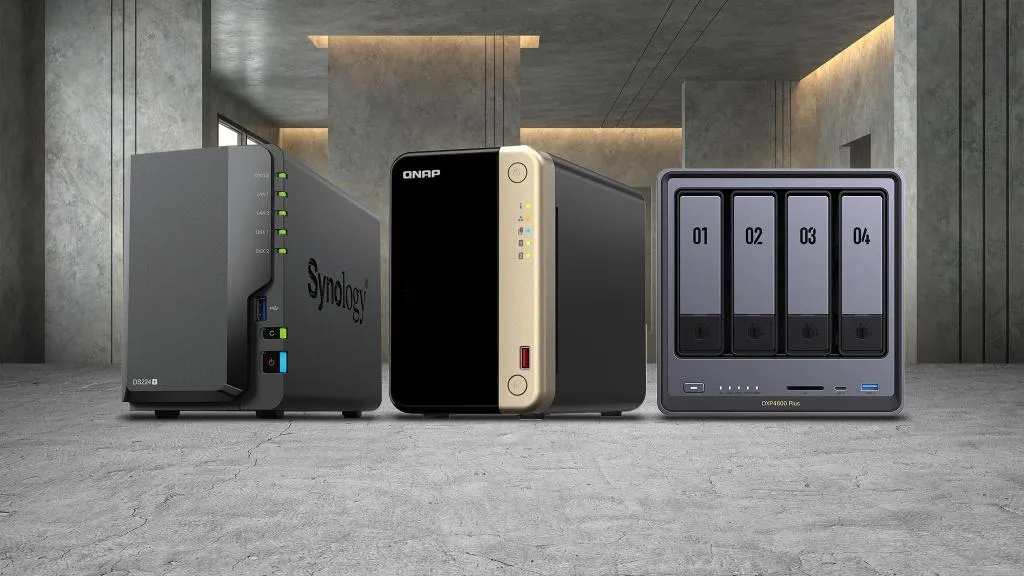
And if those files only move around inside your home or office, your own NAS lets you store and share them over your local network without depending on your plan's speed.
Why doesn't your internet reach the speed you're paying for?
Imagine you are paying for a 1 Gbps plan, but when you run a speed test you only get 300 Mbps.
That does not necessarily mean your provider is failing to deliver.
There can be several explanations.
1. Your router has limitations
Not all routers offer the same performance.
An older device can limit the available speed, especially when many devices are connected.
2. You are using Wi-Fi
Wireless performance depends on the distance to the router, walls, interference and the characteristics of your devices.
To check the performance of a fixed connection, it can help to run a test over Ethernet first.
3. Your computer has a limited network port
If your computer has a 100 Mbps Ethernet interface, you will not be able to take full advantage of a 1 Gbps plan through that port.
You should also check the category and condition of the cable you are using.
4. The network is congested
When several people are downloading or transferring files at the same time, the available capacity is split among the devices.
5. The destination server has limits too
Not every service lets you download data at your connection's maximum speed.
Even if you have 1 Gbps available, a server may deliver files at a lower speed.
How to measure your internet speed properly
Before calling your provider, you can run a few simple checks.
- Connect a computer directly to the router with a suitable Ethernet cable.
- Check that the network port has negotiated the expected speed.
- Close any apps that are downloading or syncing.
- Use a measurement service such as Speedtest.
- Run several tests at different times of day.
- Compare download, upload and latency.
- If you get unexpected results, repeat the test with a different test server.
For a more complete picture, combine your speed results with stability and packet loss tests.
A single measurement does not always reflect how your connection normally behaves.
Will we ever have petabit connections in our homes?
In theory, optical transmission technology will keep evolving.
But that does not mean homes need, or will soon get, connections of one petabit per second.
Major capacity breakthroughs usually find their first uses in backbone infrastructure, provider networks, international interconnections and data centers.
These are places where information from thousands or millions of users needs to be carried at the same time.
For example, a large artificial intelligence platform may need to move huge amounts of data between servers and processing centers.
The same goes for cloud service providers, content delivery systems and international telecommunications networks.
In those environments, increasing connection capacity can be far more important than offering extreme speeds to a single user.
Over time, some technologies developed for these networks may influence commercial connections.
But adoption depends on costs, standards, demand and the availability of compatible hardware.
Artificial intelligence is also driving demand for faster networks
When we think about artificial intelligence, we usually picture models that answer questions, generate images or produce videos.
However, behind those services there is a huge physical infrastructure.
Data centers need to move information between processors, storage systems and communication networks.
Training and running complex models can create very demanding transmission needs.
That is why research on high-capacity optical fiber has potential uses beyond entertainment or home downloads.
It can also support the growth of cloud computing, telecommunications and artificial intelligence systems.
That does not mean the Japanese record was developed exclusively for AI, but rather that this kind of progress responds to ever-growing needs for moving data.
Frequently asked questions
What is the fastest internet in the world in 2026?
It depends on what is being measured.
In terms of real-world fixed internet speeds by country, Singapore tops Ookla's September 2026 ranking, with a median download speed of 476.02 Mbps.
In experimental research, Japan demonstrated a transmission of 1.02 petabits per second over 1,808 kilometers of optical fiber in work announced in 2025.
These speeds are not directly comparable.
Which country has better internet, Japan or Singapore?
If we are talking about median fixed internet download speed in the September 2026 ranking, Singapore beats Japan.
But that does not mean Japan has worse infrastructure in every respect. Its scientific capabilities, networks, coverage and available services need to be evaluated using different indicators.
How much is 1 petabit per second?
One petabit per second equals 1,000 terabits, 1,000,000 gigabits or 1,000,000,000 megabits per second.
It is important to tell bits apart from bytes: one byte equals eight bits.
Does Chile have some of the fastest internet in the world?
Yes. In September 2026, Chile ranked fourth in Ookla's international fixed internet ranking, based on median download speed.
That does not guarantee that every town in the country has the same quality of connectivity.
Which is better, fiber or 5G internet?
It depends on your needs and the coverage available.
Optical fiber is usually an excellent choice for stable, high-capacity fixed connections.
5G offers mobility advantages and can be an alternative for fixed access in places where there is no fiber coverage.
It is not correct to assume that one technology will always be better in every situation.
Do I need 1 Gbps to play online games?
Not necessarily.
In competitive gaming, latency, stability and packet loss usually matter more than having an extremely high download speed.
A lower-capacity connection can provide a good experience if it runs reliably.
Conclusion: the future of the internet is not just about faster downloads
The 1.02 petabits per second record set by Japanese researchers shows how far optical transmission technology can go.
And the advances announced in 2026 show that there is still room to increase the capacity of infrastructure that is already installed.
But the real importance of this research is not about downloading a movie in a fraction of a second.
It is about building networks that can keep up with a society that generates, stores and transmits ever-larger amounts of information.
At the same time, countries like Singapore and Chile show how expanding connectivity can translate into high speeds for users.
The next time you compare internet plans, remember that download speed is only one part of the experience.
A good connection also needs stability, low latency, upload capacity and reliable infrastructure.
Because having the fastest internet does not always mean having the best internet for your needs.
About the author
Rafael Azuaje is a computer engineer with experience in web development and UX/UI design. He shares educational content about technology, artificial intelligence and automation, with a practical approach to help people understand how digital tools work.
References